Your resume's skills section is basically a bouncer with a clipboard. The applicant tracking system (ATS) reads down the list, checks it against the job description, and decides whether your name is on it. List the wrong skills — or the right ones phrased oddly — and you're left out in the cold while less-qualified people walk right in.
Good news: picking the right skills isn't guesswork. It's matching.
Hard skills vs soft skills
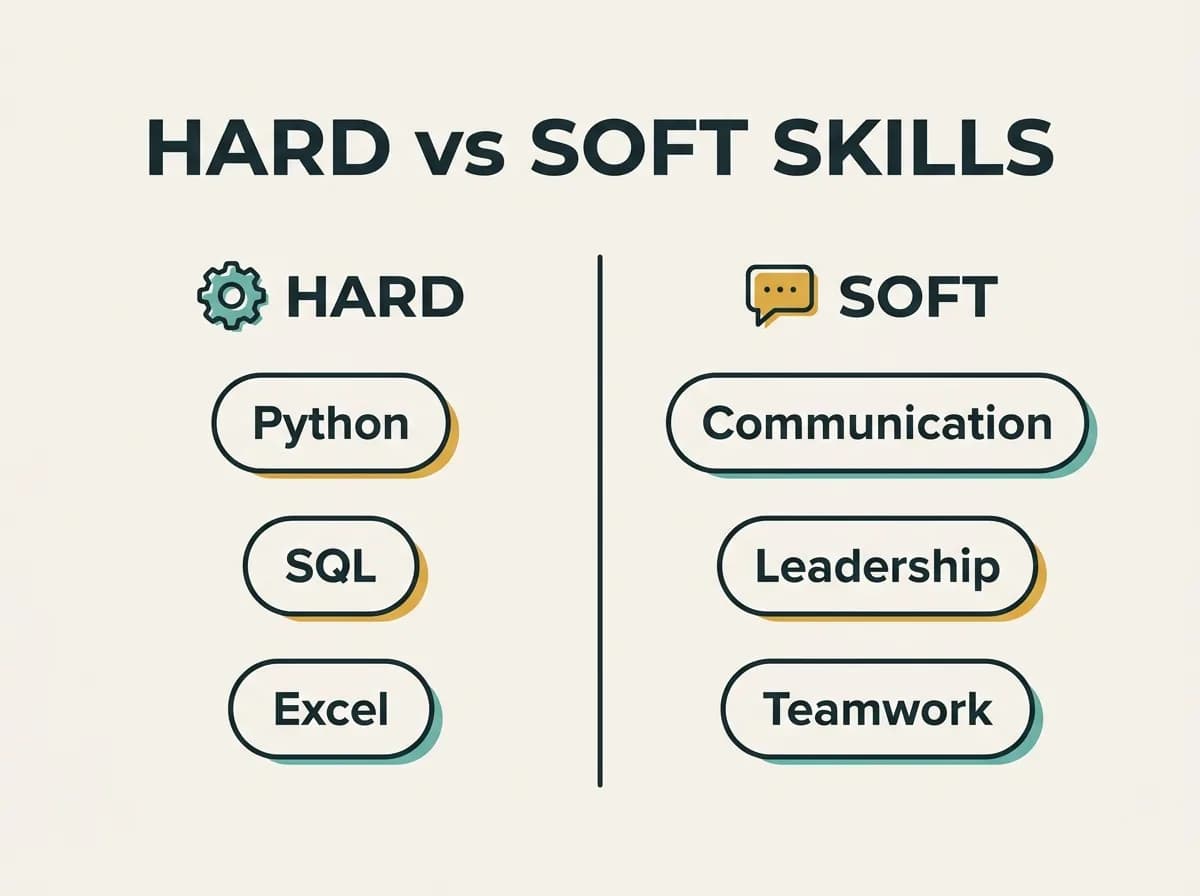
Hard skills are teachable and testable: Python, financial modeling, IV therapy, Adobe Illustrator. Soft skills are how you operate: communication, leadership, problem-solving. The ATS mostly hunts for hard skills, because they map cleanly to keywords. Humans care about the soft ones — but only once you're in the room. So you need both, weighted toward hard skills up top.
How an ATS actually reads your skills section
It doesn't admire your design. It extracts text, then matches it against the posting. Two things follow:
- Exact wording matters. If the job says "customer relationship management" and you wrote "CRM," include both. The parser isn't great at synonyms.
- Context beats a list. A skill that also appears next to a real result ("automated reporting in SQL, saving 10 hours/week") scores higher than the same word floating alone in a box.
- Placement counts. A skill buried in the last line of your oldest job carries less weight than the same skill in a dedicated section near the top. Parsers and recruiters both read top-down.
Here's the part most guides skip. When we built Talorr's resume parser, the single most common reason a real skill went "missing" was not a missing skill at all: it was a skill trapped in a two-column layout, a text box, or a graphic. The applicant read as unqualified because the software literally could not see half the page. The lesson: your skills only count if they're in clean, single-column body text. More on that in how to optimize your resume for ATS.
100+ skills by role
Steal the ones that are genuinely yours:
- Software / Engineering: Python, JavaScript, React, SQL, REST APIs, Git, Docker, AWS, unit testing, system design
- Data: SQL, Excel, Python/R, Tableau, Power BI, ETL, A/B testing, data modeling, forecasting, statistics
- Product / PM: roadmapping, user research, prioritization, A/B testing, Agile/Scrum, SQL, stakeholder management, go-to-market
- Marketing: SEO, SEM, GA4, HubSpot, paid social, email marketing, content strategy, conversion optimization, copywriting
- Sales: prospecting, Salesforce, pipeline management, negotiation, forecasting, account management, consultative selling
- Finance / Accounting: GAAP, reconciliations, month-end close, AP/AR, NetSuite, QuickBooks, Excel modeling, variance analysis
- Healthcare / Nursing: patient assessment, medication administration, Epic/Cerner EHR, IV therapy, BLS/ACLS, care coordination
- Customer Service / Support: Zendesk, CRM software, ticketing, de-escalation, product knowledge, SLA management, live chat, troubleshooting
- Operations / Project Management: Agile/Scrum, Jira, process improvement, vendor management, budgeting, risk management, resource planning, KPIs
- HR / Recruiting: applicant tracking systems, onboarding, employee relations, benefits administration, HRIS (Workday), sourcing, compliance
- Design / Creative: Figma, Adobe Creative Suite, prototyping, design systems, user research, wireframing, brand identity, accessibility
- Soft skills (everyone): communication, leadership, problem-solving, adaptability, time management, collaboration
Notice these are nouns and named tools, not vague verbs. "Communication" is a soft skill worth listing once; "good with people" is not a skill, it's a horoscope.
Transferable skills that travel across roles
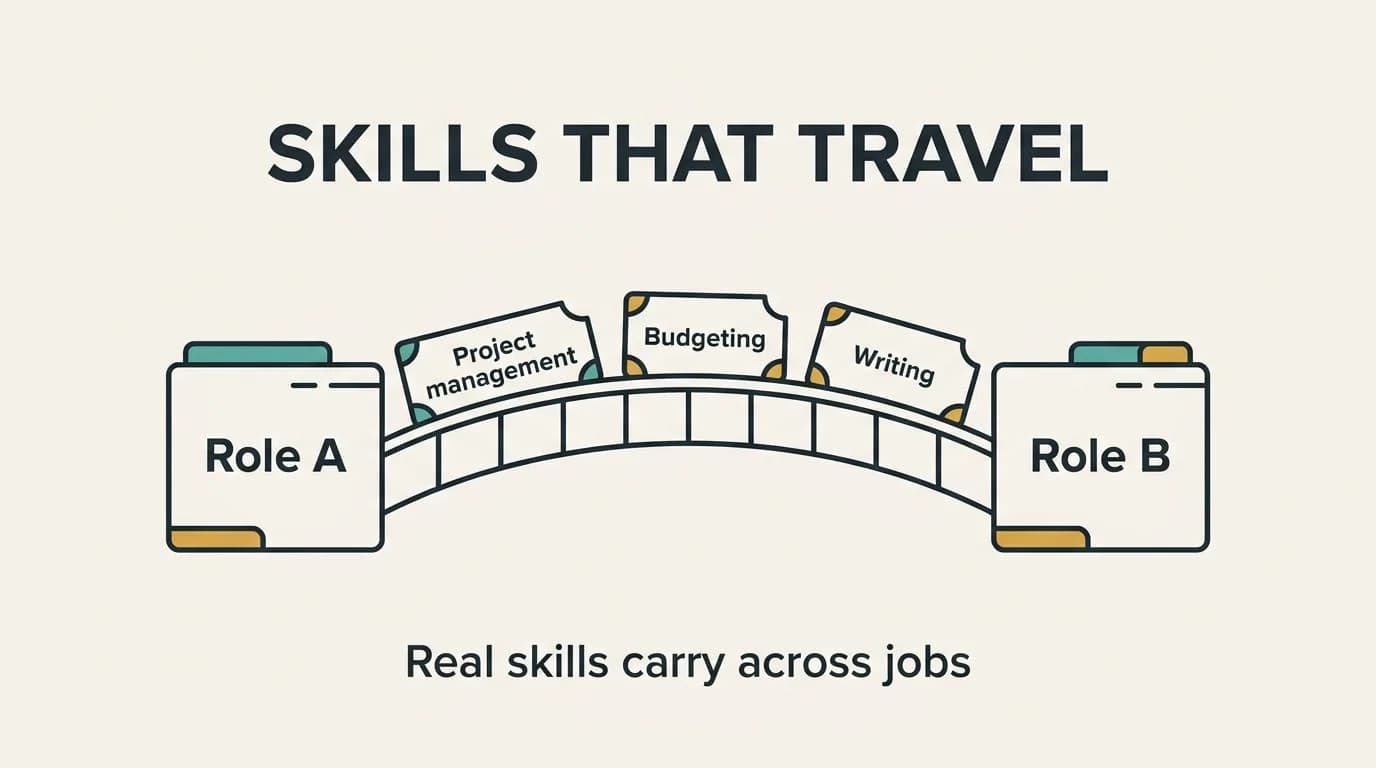
Changing industries or coming back from a gap? Transferable skills are your bridge. They're real, provable abilities that carry from one context to another: project management, budget ownership, data analysis, writing, stakeholder management, training others, and process design. If you're not sure which skills are standard for a target role, the US Department of Labor's O*NET database lists them occupation by occupation. A career changer or returning parent should lead with these, then anchor each to a concrete result so it reads as experience, not aspiration.
The skills employers actually want in 2026
Two shifts are worth reflecting on your resume this year:
- AI fluency, stated honestly. "Prompt engineering," "using AI tools to automate X," or a named tool you genuinely use now reads as modern rather than gimmicky. Just keep it truthful and specific to your work.
- Data literacy in non-data roles. Marketers who can read GA4, ops people who live in spreadsheets, PMs who write SQL. Employers increasingly expect basic analytical skill regardless of title.
Both are only worth listing if you can back them up in an interview. A skill you can't defend is a trap you set for yourself.
How to pick the right 8–12 skills for each job
Don't list all of them. Listing 40 skills tells a recruiter you have no idea which ones matter.
- Read the posting and highlight every skill that appears more than once or sits in "requirements."
- Cross-reference with what you can actually defend in an interview.
- Put the overlap — usually 8 to 12 — in your skills section, front-loaded with the must-haves.
Where to put them (and what to skip)
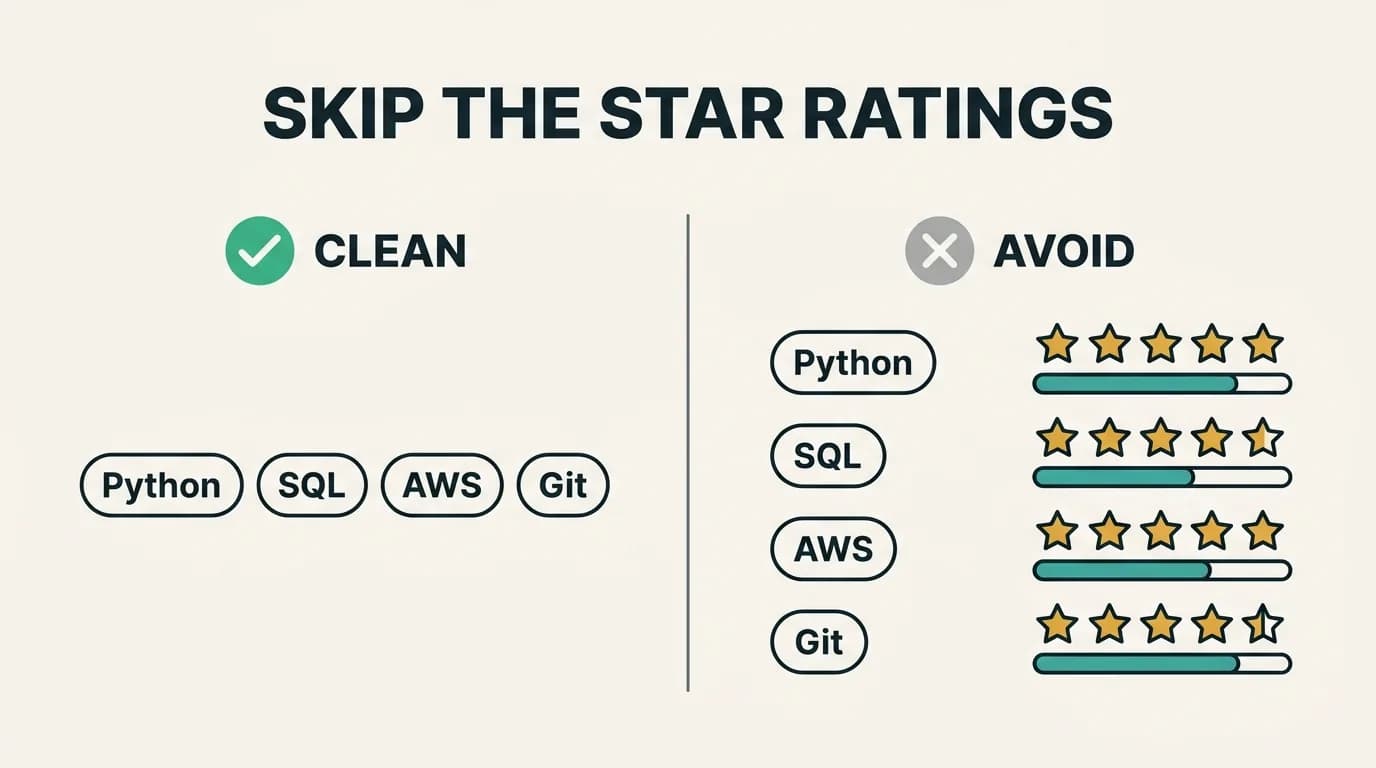
Group them in a clean Skills section near the top, and weave the top three into your summary and bullets. Skip the skill bars and star ratings — "Python: 4/5 stars" means nothing to a recruiter and gets dropped entirely by the ATS. Also skip skills so basic they're insulting to list (yes, you can use email).
What a strong skills section looks like
Format matters as much as choice. A clean, scannable block wins:
Skills Python · SQL · JavaScript (React) · AWS · Docker · REST APIs · Git · Unit Testing · System Design · Agile
That's ten defensible, job-relevant skills in one parseable line-group. Compare it to the anti-pattern: a decorative grid of 35 skills with progress bars, half of them soft-skill clichés, none of them proven anywhere else on the page. The first says "I know exactly what this role needs." The second says "I pasted a list from the internet."
Skills recruiters are tired of seeing
Some entries actively cost you credibility because everyone claims them and nobody proves them:
- "Hard worker," "team player," "detail-oriented" — show these in your bullet points, never claim them in a list.
- "Microsoft Word," "email," "internet research" — assumed for any office role since roughly 2005.
- "Fast learner" — the resume equivalent of "good vibes."
Cut the filler and the real skills stand out by contrast.
Skills, keywords, and the ATS
Your skills section is also your densest source of ATS keywords. That's exactly why mirroring the job's wording matters, and it's why you should tailor your resume to each job description rather than sending one static list to every posting. And no, using AI to help phrase them won't hurt you — an ATS can't detect AI-assisted resumes; it only cares whether the keywords match.
Match your skills to any job, automatically
Reading every posting by hand works, but it's tedious. Talorr scans any job description, shows the exact skills you're missing, and helps you phrase them the way the ATS expects — so your bouncer always has the right guest list.
Frequently asked questions
- How many skills should I put on a resume?
- Aim for 8 to 12 in your skills section — the overlap between what the job asks for and what you can genuinely defend. Listing 30+ skills dilutes the important ones and signals you didn't tailor your resume.
- Should I list soft skills on my resume?
- A few, yes — but prove them in your bullets rather than just claiming them. ATS filters mostly match hard skills and keywords, so lead with those and let soft skills show up through your achievements.
- What are the best skills to put on a resume in 2026?
- The best skills are the ones that appear in your target job description and that you can genuinely defend. Beyond role-specific hard skills, employers increasingly value honest AI fluency (named tools you actually use) and basic data literacy even in non-technical roles. Always match the posting's exact wording.
- Where should the skills section go on a resume?
- Near the top, in a clean single-column block using standard text — not in a sidebar, table, or graphic, which ATS parsers often can't read. Weave your top two or three skills into your summary and bullet points as well, so they appear in context with real results.