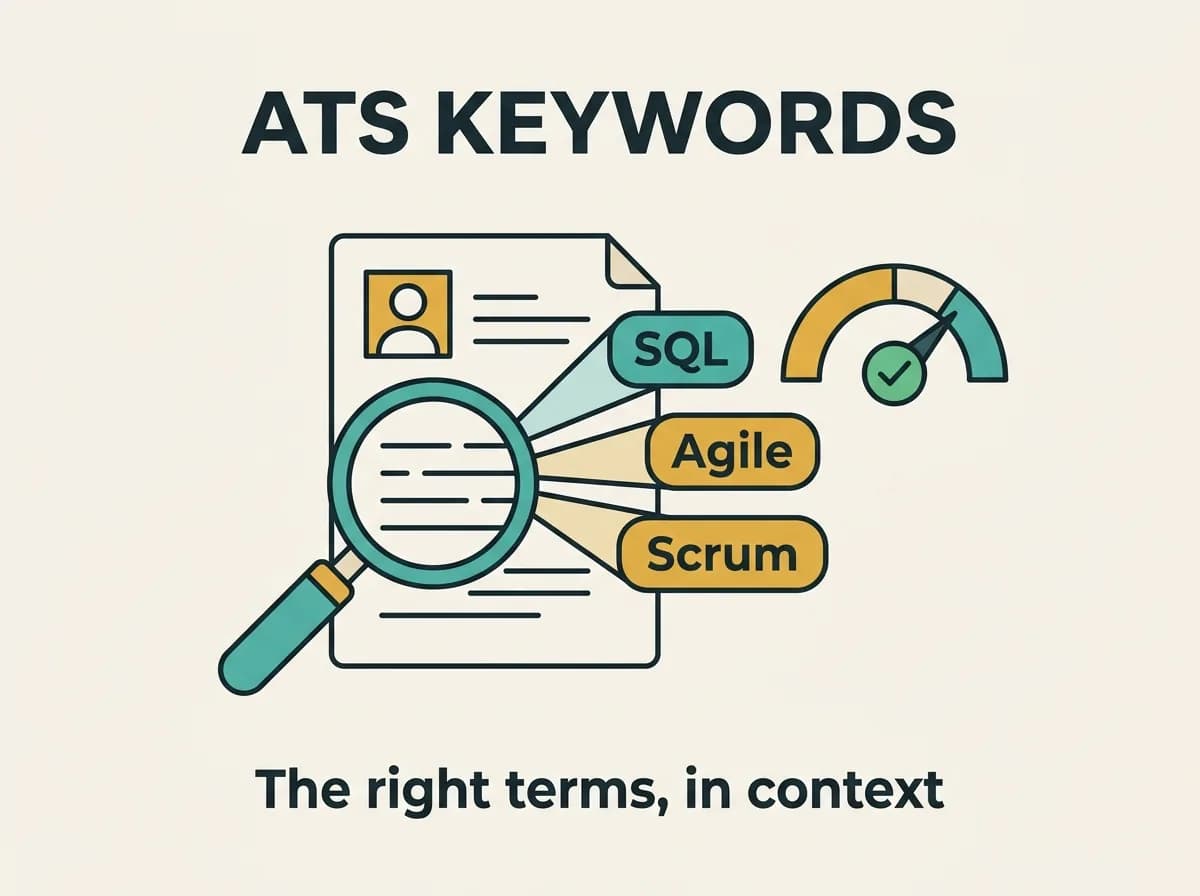
Most advice about "ATS keywords" is a decade out of date. Stuffing your resume with every term from the job description, hiding white text, or dumping a wall of skills no longer works — modern semantic systems detect and penalise it. The 2015 playbook of white-text keyword stuffing now works about as well as paying for a taxi with Monopoly money. Here's how keyword matching actually works in 2026, and how to use it to your advantage.
How ATS keyword scoring works now
Two signals decide whether you pass:
- Parsing confidence — can the system cleanly extract your text? Tables, text boxes, and contact details in headers or footers often break extraction. Use a single-column, reverse-chronological layout.
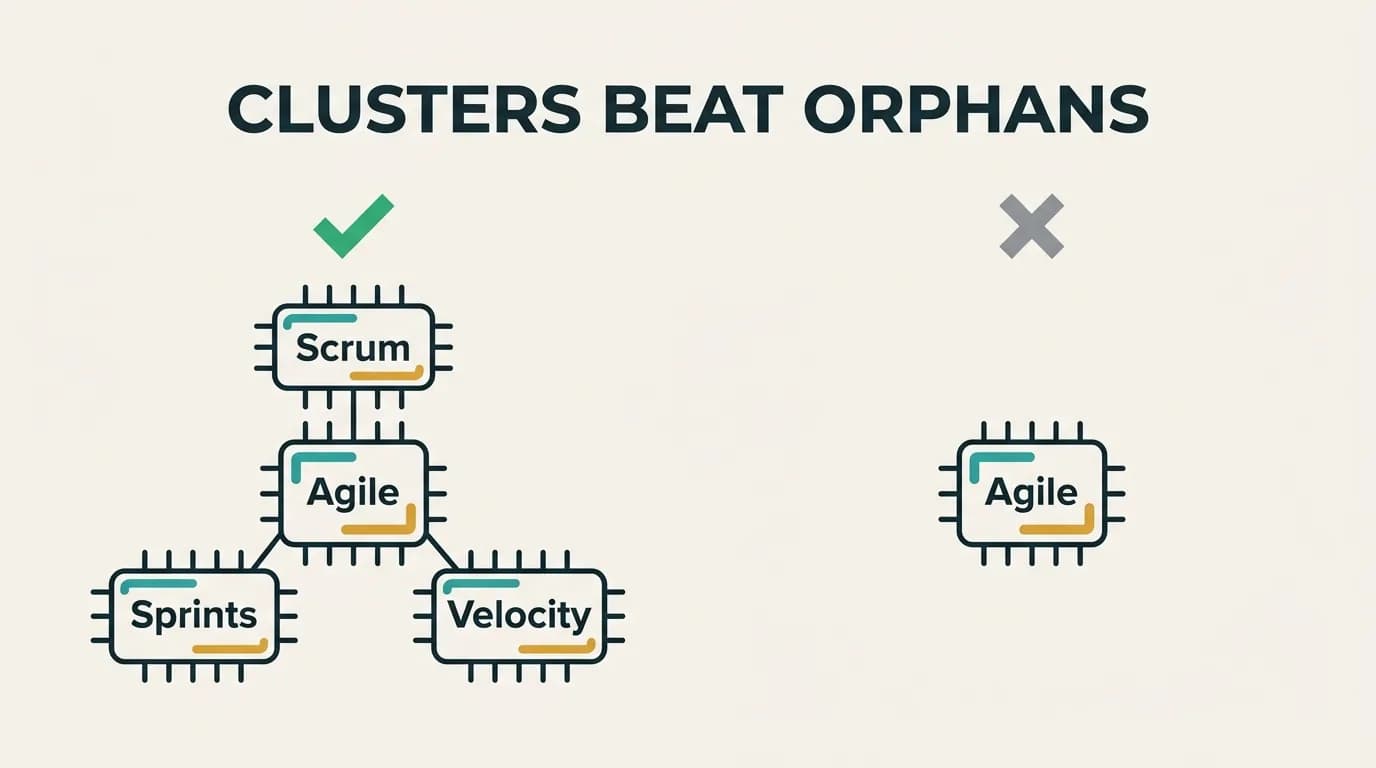
- Semantic relevance — clusters of related terms beat orphan keywords. A bullet that mentions "Scrum," "sprints," and "velocity" signals real Agile experience far more strongly than the word "Agile" sitting alone in a skills box.
Find the right keywords in three steps
- Aggregate 5–10 postings for the same target role, not just one.
- Mark the repeating noun phrases — tools, technologies, methods, and certifications that show up across multiple listings.
- Prioritise terms that appear in at least three of those postings. Those are your highest-value keywords; everything else is supporting context.
The job description is the single best source, but you can cross-reference O*NET, the US Department of Labor's occupational database, for occupation-standard skills and skim what successful candidates in similar roles list on LinkedIn.
Where to place keywords
- Summary — 2–3 high-priority terms that define your target lane.
- Skills section — tools, platforms, certifications, and core methods, for scanability.
- Experience bullets — this is where keywords become believable, because they sit next to outcomes and scope.
- Projects or certifications — useful proof for career changers or lighter direct experience.
The cluster rule
If a job requires "financial modelling," don't just repeat that phrase. Surround it with related terms in your bullets: DCF analysis, variance reporting, P&L forecasting, scenario planning. The cluster proves depth; the keyword alone proves nothing.
A worked example
Say the posting is for a "Data Analyst" and repeats: SQL, dashboards, stakeholder reporting, A/B testing.
- Weak (orphaned keyword): a skills line reading "SQL, dashboards, A/B testing" and nothing else.
- Strong (keyword in a cluster): "Built SQL dashboards that cut weekly stakeholder reporting from 6 hours to 1, and ran A/B tests that lifted activation 14%."
Same four keywords. The second version proves them with scope and a result — which is exactly what both the semantic ATS and the human reviewer are scoring. Pick the right terms from your resume skills and place them in dated bullets like this.
How many keywords is enough?
A strong resume covers roughly 15–25 distinct keywords, centred on 5–8 core competencies, each appearing one to three times in context. On a one-page resume, 40 keywords reads as stuffed. On a two-page senior resume, 10 reads as light on signal. Match density to length.
Avoid these mistakes
- Orphaned keywords — never list a critical skill only in your skills section. Every high-priority term should appear in at least one dated bullet under a named employer.
- Acronym-only or full-term-only — include both, e.g. "Search Engine Optimization (SEO)" and "Amazon Web Services (AWS)," so you match either query.
- Chasing 100% match — target 70–80%. A perfect match looks engineered and leaves no room for your own voice.
Test before you submit
After your keyword pass, score your resume against the actual posting rather than assuming it worked. Keywords are one half of clearing the ATS; the other half is clean formatting the parser can read, and the whole thing is easiest when you tailor to each job description. Talorr's analyzer extracts the keywords from any job description, shows your match score and the exact terms you're missing, and lets you fix them in one click — so you can stop guessing whether you'll clear the filter.
Frequently asked questions
- How many keywords should a resume have?
- Aim for 15–25 distinct, relevant keywords across hard and soft skills, centred on 5–8 core competencies, each used one to three times in context. Match the density to the resume's length.
- Does keyword stuffing still work on ATS systems?
- No. Modern semantic ATS platforms detect and penalise unnatural repetition, hidden text, and dense keyword blocks. Skills woven into experience bullets consistently outperform standalone keyword lists.