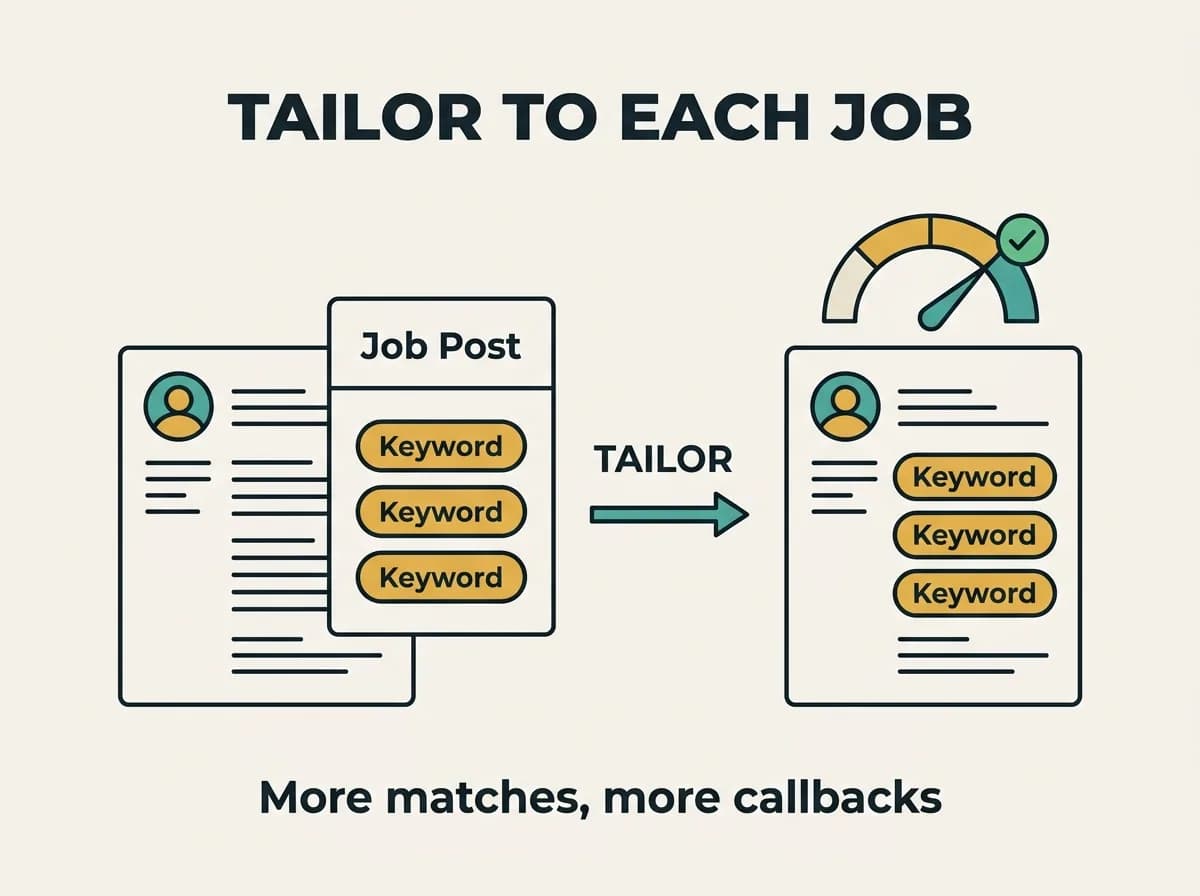
Sending one generic resume to 40 jobs is the application equivalent of wearing the same outfit to a wedding, a funeral, and a job interview. Technically you're dressed. You're also clearly not paying attention. Tailoring your resume to each job description is the highest-leverage move in the whole search — and it doesn't mean rewriting from scratch. Here's the process.
Why tailoring works
Two audiences read your resume, and both reward tailoring:
- The ATS ranks you on how well your resume matches the posting's keywords. Generic resume, generic match, low rank.
- The recruiter spends six seconds deciding if you're relevant. A resume that mirrors the role feels written for them — because it was.
Tailoring isn't about gaming the system. It's about proving the same true experience is the right experience for this specific job.
Step 1 — Mine the job description
Read the posting and highlight three things: the must-have skills, the exact job title, and any repeated keywords. Anything mentioned twice or sitting in "requirements" is non-negotiable. That highlighted list is your target.
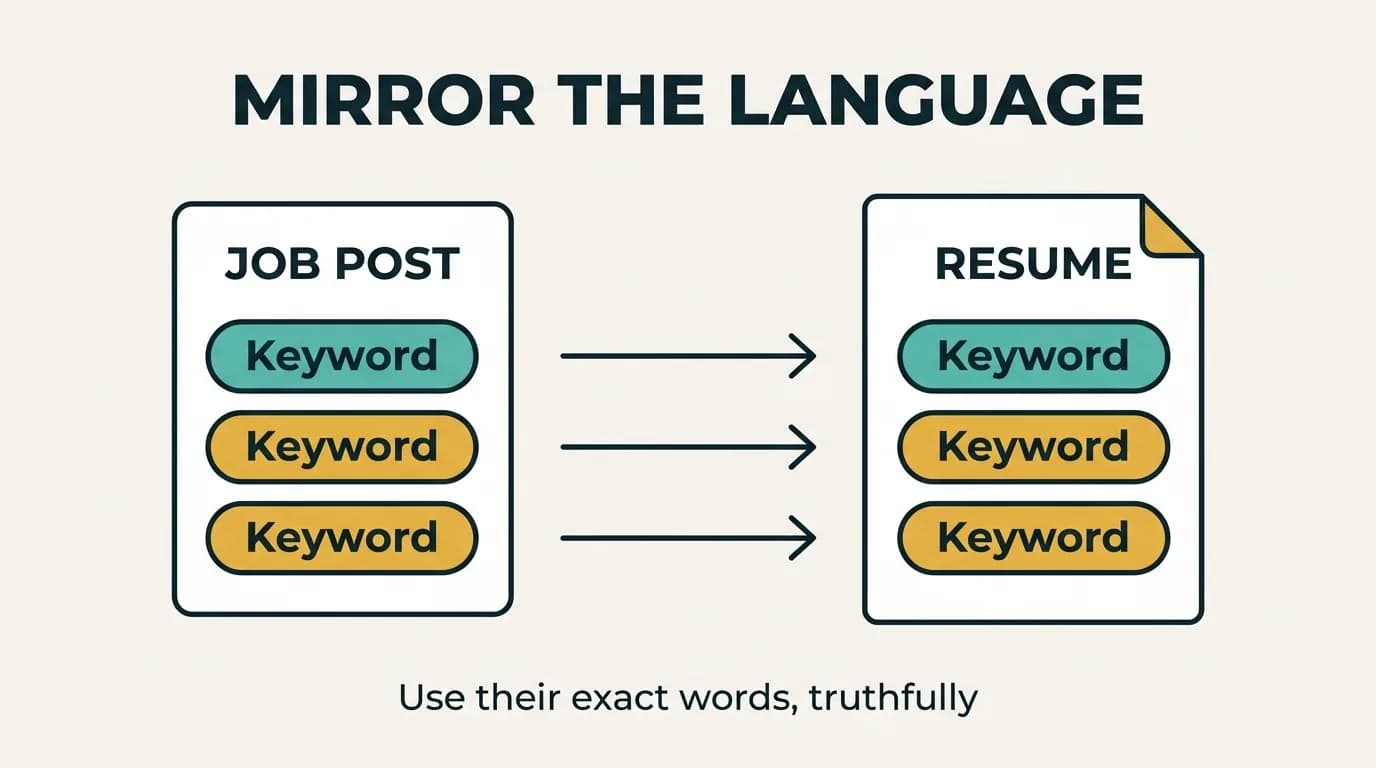
Step 2 — Mirror the language (truthfully)
Now match your resume's wording to theirs, wherever it's honestly true. If they say "stakeholder management" and you wrote "worked with teams," adopt their phrase. The parser is bad at synonyms, so speak its language. If a required skill genuinely isn't yours, leave it out — tailoring is emphasis, not fiction.
Step 3 — Reorder for relevance
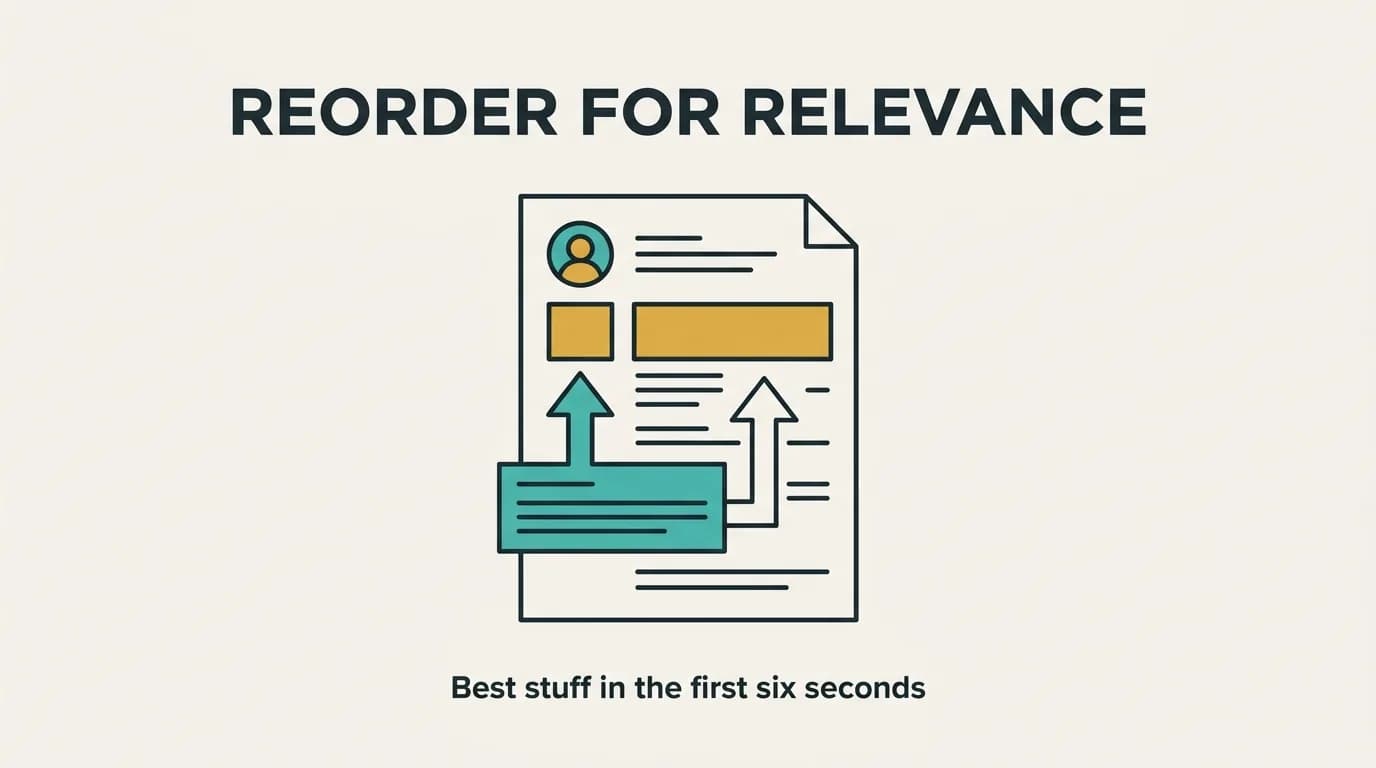
Put the most relevant experience and skills near the top. Your summary should lead with your strongest qualification for this role, and your skills section should front-load the must-haves from Step 1. Same content, resequenced so the good stuff hits in the first six seconds.
Step 4 — Tune your bullets
Rewrite a few key bullet points to echo the role's priorities, keeping your real numbers. If the job is about growth, lead with the growth metric. If it's about reliability, lead with uptime. Same achievement, angled at what they care about.
Here's the same bullet, tailored two ways for two different jobs:
- Original: "Managed the analytics dashboard and reporting for the marketing team."
- For a growth role: "Built analytics dashboards that surfaced the channels driving 60% of pipeline, guiding budget reallocation."
- For an ops role: "Automated weekly reporting in SQL, cutting 10 hours of manual work per week across the marketing team."
One true achievement, two honest angles, each aimed at what that specific employer values.
How much should you actually change?
Tailoring is not rewriting from scratch, and it's not a full-time job. For each application, focus on the four highest-leverage spots:
- The professional summary — swap in the target title and lead proof.
- The skills section — reorder to front-load the must-haves.
- The top two or three bullets of your most recent role.
- The keywords throughout, matched to the posting's wording.
Everything else can usually stay put. That's 10 to 15 minutes of focused editing per job, not an afternoon.
Step 5 — Score before you send
Don't guess whether you nailed the match. Check the ATS score against the actual posting and close any keyword gaps it flags. This is the difference between hoping and knowing.
The 60-second tailoring checklist
Before you hit submit, run through this:
- Target job title appears in your summary and ideally your most recent role.
- The posting's must-have skills are present, in its exact wording, and true.
- Your top two or three bullets speak to this role's priorities.
- Skills section is reordered to front-load what this job cares about.
- ATS match score checked, keyword gaps closed.
If all five are ticked, you've done more than roughly 90% of applicants — most of whom sent the same generic resume you almost did.
The honest catch: it's slow by hand
Doing all five steps for every application is correct and exhausting. By job number five, most people quietly revert to spray-and-pray. You can use ChatGPT prompts to speed it up, but you'll still be copy-pasting and babysitting the output.
Tailor in one step with Talorr
This is exactly what Talorr automates. Paste a job link to tailor your resume: it surfaces the missing keywords, rewrites your bullets from your real experience, mirrors the posting's language, and shows your match score climb — the whole five-step process, in about a minute.
Frequently asked questions
- How do I tailor my resume to a job description?
- Highlight the must-have skills, exact title, and repeated keywords in the posting, then mirror that language truthfully on your resume, reorder your summary and skills to lead with the most relevant experience, tune a few bullets to the role's priorities, and check the ATS match score before sending.
- Do I need to tailor my resume for every job?
- Yes, for any job you genuinely want. Tailoring is the biggest factor in both ATS ranking and recruiter interest. You don't rewrite from scratch each time — you adjust keywords, ordering, and a few bullets to match each specific posting.
- How long does it take to tailor a resume?
- About 10 to 15 minutes per application once you know the process. Focus only on the high-leverage spots: the summary, the skills ordering, your top two or three bullets, and the keywords. AI tools like Talorr can cut this to about a minute.
- Is tailoring a resume the same as lying?
- No. Tailoring is emphasis, not invention — you reorder, rephrase, and highlight the true experience most relevant to each job, and mirror the posting's wording. You never add skills, titles, or numbers you can't back up. Fabrication fails the moment an interviewer asks a follow-up.