Recruiters spend about six seconds on a resume, and they spend most of it scanning your bullet points. So if your bullets start with "Responsible for," you've already lost a few of those precious seconds to a phrase that says nothing. Let's fix that.
The formula
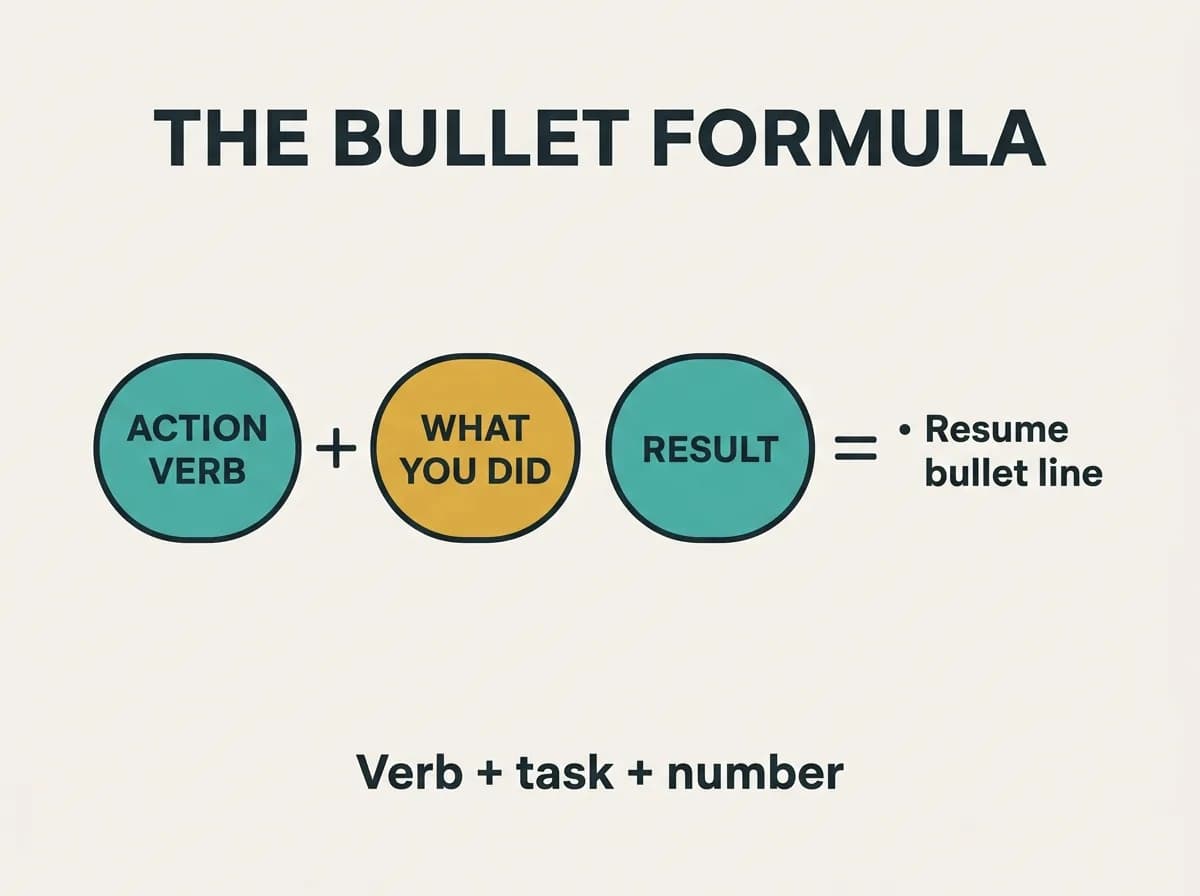
Every strong bullet follows the same shape:
Action verb + what you did + measurable result.
That's it. Lead with a verb, describe the work, and end with a number or clear outcome. Example:
Automated weekly reporting in SQL, cutting manual work by 10 hours per week.
Verb (Automated), what (weekly reporting in SQL), result (10 hours/week saved). Six-second-proof.
Start with a real verb
Open every bullet with a strong past-tense verb: Built, Led, Reduced, Launched, Negotiated, Automated, Designed. Banish the dead openers:
- "Responsible for…" — describes a job description, not an achievement.
- "Helped with…" — how much? doing what?
- "Worked on…" — the resume equivalent of a shrug.
Add a number, even an estimate
Numbers are what survive a six-second scan. Quantify whenever you honestly can: percentages, dollars, time saved, headcount, volume. No metrics handy? Reasonable scope still beats nothing: "across 3 teams," "for 12 clients," "managing a $50k budget."
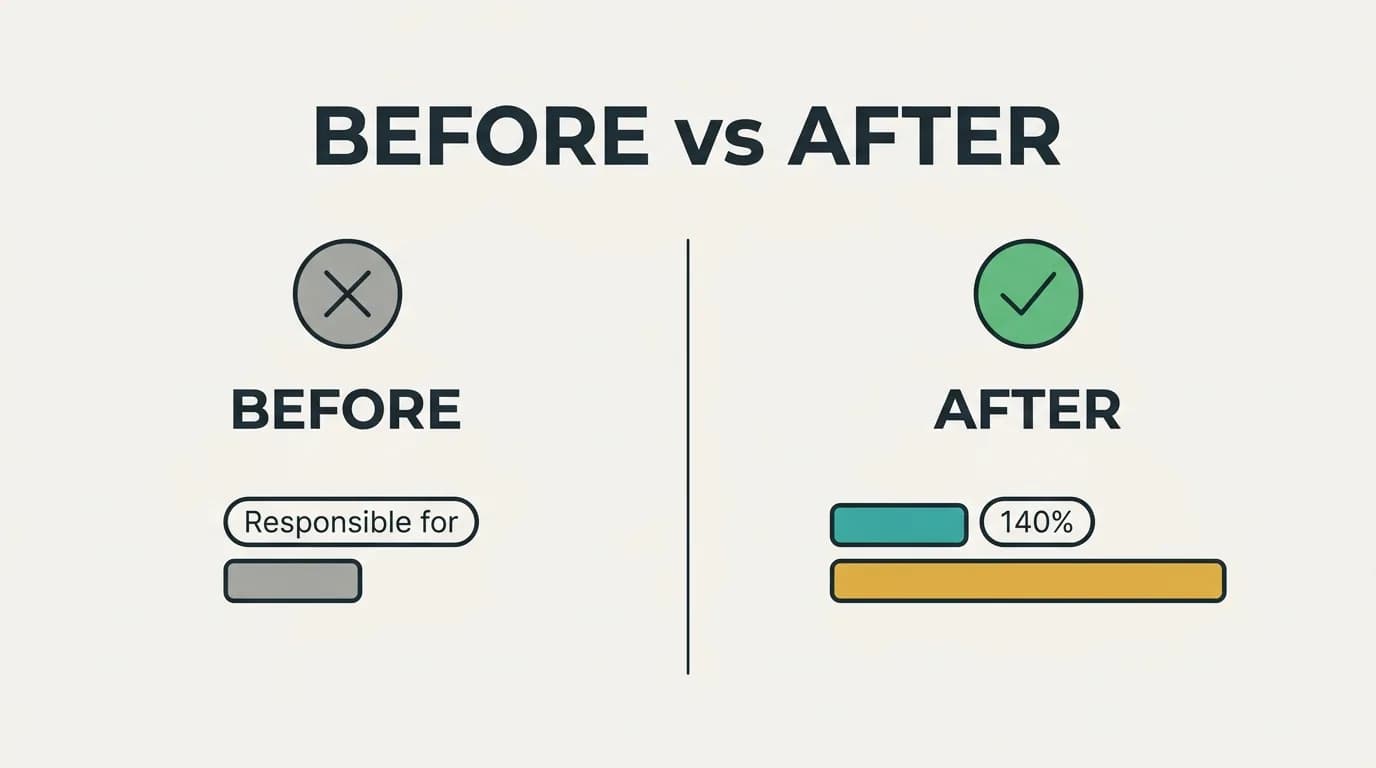
Before and after
-
Before: Responsible for social media accounts.
-
After: Grew Instagram following 140% in 6 months by launching a weekly series, driving 2,000 site visits.
-
Before: Helped improve the onboarding process.
-
After: Redesigned onboarding flow, lifting activation rate from 48% to 71% in one quarter.
Same work. Wildly different impression.
Match the bullet to the job
Strong bullets still need to match the posting. Weave in the skills the job asks for using the employer's wording, since the ATS scores keyword matches. A quantified bullet that also contains the right keyword does double duty — see how to optimize your resume for ATS.
Keep them tight
One line each, two at most. Three to five bullets per recent role, fewer as you go back in time. If a bullet doesn't show impact or relevance, cut it. White space is a feature, not a bug.
Let Talorr do the rewriting
Turning "responsible for" into a quantified, keyword-matched bullet for every job is slow. Talorr rewrites your existing bullets to match any posting — keeping your real numbers, mirroring the job's language, and showing your ATS match score as you go.
Frequently asked questions
- How do I write good resume bullet points?
- Use the formula: action verb + what you did + measurable result. Start with a strong verb like Built or Reduced, describe the work, and end with a number or clear outcome. Avoid openers like 'Responsible for' and keep each bullet to one or two lines.
- How many bullet points should each job have?
- Use three to five bullets for your most recent and relevant roles, and fewer (two to three) for older positions. Prioritize bullets that show measurable impact and match the job you're applying to, and cut anything that doesn't.