
Your professional summary is the most valuable real estate on your resume. It's the first thing a recruiter reads and, combined with your top bullets, it decides whether the rest of the page gets attention. A vague summary wastes that moment; a sharp one earns the next twenty seconds.
What a good summary does
A strong summary answers three questions immediately:
- Who are you? Your target role and seniority.
- What's your proof? One or two standout, quantified achievements.
- Why this job? A signal that you match what the posting is asking for.
Skip the objective statement ("Seeking a challenging role where I can grow…"). It's about what you want; recruiters care about what you deliver.
A simple formula
[Role + years of experience] who [signature strength], with a track record of [quantified achievement]. Skilled in [2–3 priority keywords from the posting].
Keep it to two to four sentences. Lead with the target title so both the recruiter and the ATS recognise the lane instantly.
Resume summary examples
Software engineer
Senior frontend engineer with 8 years building high-traffic web apps. Cut page load time 40% and led a 5-person team through a React migration. Skilled in TypeScript, Next.js, and design systems.
Marketing manager
Growth marketing manager with 6 years scaling B2B SaaS pipelines. Grew inbound demo requests 3x in 12 months through SEO and lifecycle email. Skilled in HubSpot, paid search, and conversion optimisation.
Recent graduate
Computer science graduate with two internships shipping production features and a capstone app used by 500+ students. Comfortable across the stack with Python, React, and SQL, and eager to grow as a backend engineer.
Career changer
Operations lead moving into product management, with 7 years turning messy processes into scalable systems. Cut order-processing time 35% and shipped two internal tools end to end. Skilled in roadmapping, stakeholder alignment, and data analysis.
Registered nurse
Compassionate RN with 5 years in high-acuity med-surg units. Maintained a 98% patient-satisfaction score while managing up to 6 patients per shift. Skilled in EHR (Epic), IV therapy, and interdisciplinary care coordination.
Sales representative
B2B sales rep with 4 years exceeding quota in SaaS. Closed $1.2M in new ARR last year at 118% of target. Skilled in Salesforce, consultative selling, and pipeline management.
Accountant
Staff accountant with 5 years in month-end close and reconciliations. Cut close time from 10 days to 6 by automating recurring entries. Skilled in GAAP, NetSuite, and Excel modeling.
Customer service representative
Customer support specialist with 3 years in fast-paced e-commerce. Resolved 45+ tickets daily at a 96% CSAT while mentoring two new hires. Skilled in Zendesk, de-escalation, and product troubleshooting.
Want a full document to match your summary? Browse our resume examples by role for complete, ATS-friendly samples.
How the summary changes by experience level
The formula stays the same; the emphasis shifts:
- Entry-level / graduate: lead with education, projects, and internships. You have less to quantify, so highlight scope ("app used by 500+ students") and eagerness to grow in a specific direction.
- Mid-level: lead with your strongest quantified win and the skills the job prioritizes. This is where the standard formula shines.
- Senior / leadership: lead with scale and outcomes — team size, budget owned, revenue influenced — not a task list. Recruiters want to see the altitude you operate at.
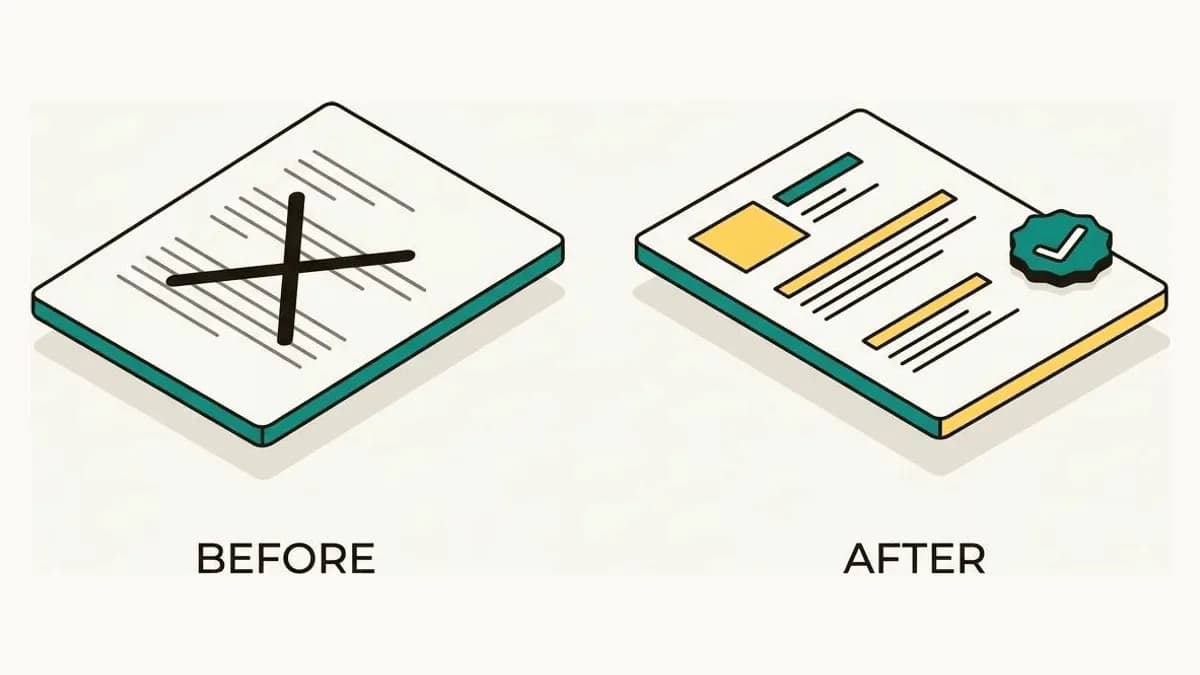
Before and after: fixing a weak summary
- Before: "Experienced professional seeking a challenging role to utilize my skills and grow with a dynamic company."
- After: "Growth marketing manager with 6 years scaling B2B SaaS pipelines. Grew inbound demos 3x in a year via SEO and lifecycle email. Skilled in HubSpot, paid search, and CRO."
The "before" is about what you want and could belong to literally anyone. The "after" names the role, proves it with a number, and mirrors the posting's keywords. That's the entire game.
Tailor it to every job
The summary is the first thing you should rewrite for each application. Swap in the exact target title, lead with the achievement most relevant to that posting, and mirror two or three of its priority keywords. A tailored summary does more for your callback rate than almost any other single edit — and it's worth checking your ATS match afterward to confirm the wording landed.
Common mistakes
- Generic adjectives — "hard-working, detail-oriented, results-driven" say nothing. Show, don't claim.
- No numbers — every summary should contain at least one quantified result.
- Too long — more than four sentences and it stops being a summary.
- Copy-paste across jobs — a static summary signals a generic application.
Talorr writes and rewrites your summary against any job description, so it always leads with the right title, the right proof, and the right keywords for the role in front of you.
Frequently asked questions
- What should a resume summary include?
- Your target role and seniority, one or two quantified achievements as proof, and two or three priority keywords from the job posting — all in two to four sentences.
- Is a resume summary or an objective better?
- A summary. Objective statements focus on what you want; a summary leads with what you deliver, which is what recruiters and ATS systems are scanning for.
- How long should a resume summary be?
- Two to four sentences, roughly 40 to 60 words. Long enough to state your target role, one or two quantified proofs, and a few priority keywords — short enough that a recruiter reads it in the first few seconds without skimming past.
- Do I need a summary if I have no experience?
- It helps. With little work history, lead your summary with your degree or field, relevant projects or internships, and the direction you want to grow. It frames the rest of the resume and gives the recruiter context before they reach your (shorter) experience section.