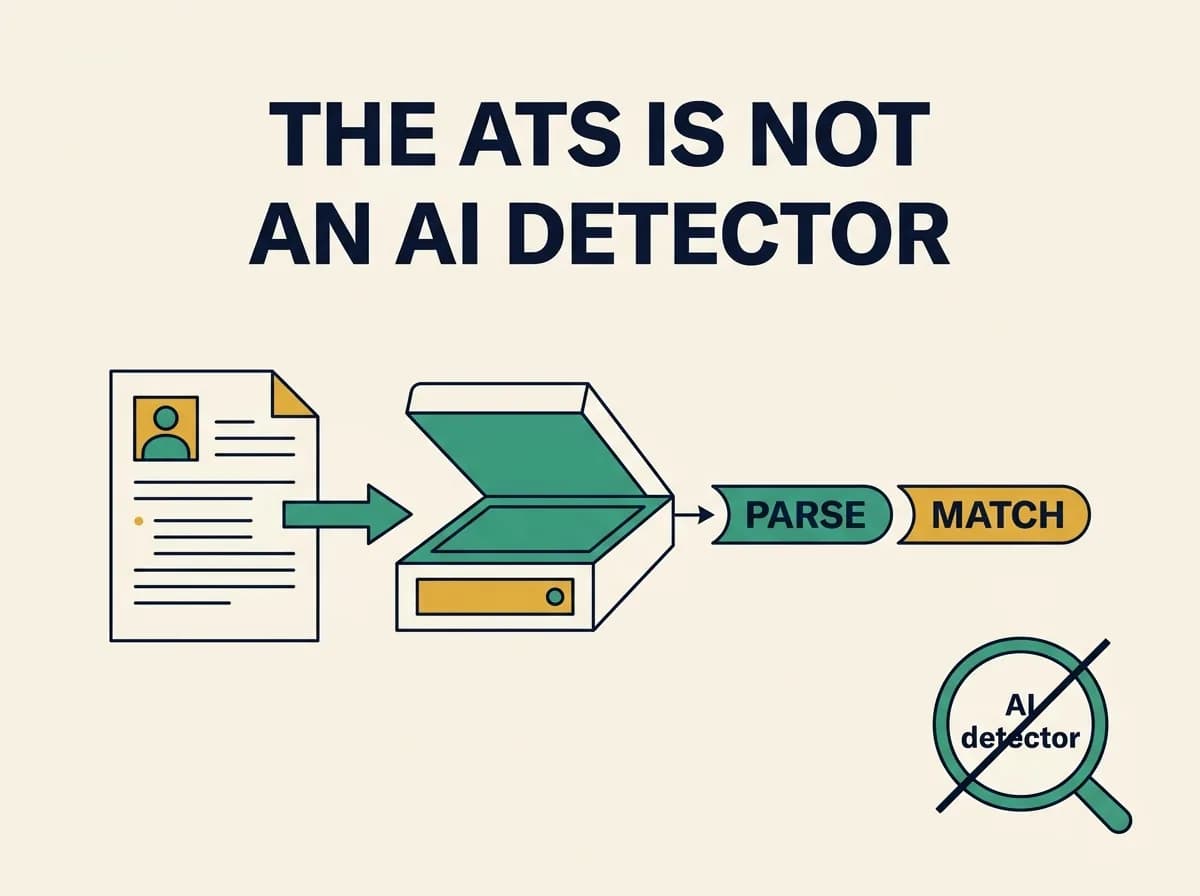
Let's defuse the anxiety in one sentence: an applicant tracking system (ATS) does not run your resume through an "AI detector." It parses your text and matches it against the job description. That's the whole job. There is no little robot squinting at your bullet points wondering if a chatbot wrote them.
So no — using AI to help with your resume will not get you auto-rejected by the ATS. What can hurt you is something else entirely. Let's break it down.
What an ATS actually does
Two steps, neither of them dramatic:
- Parse — extract your text into structured fields (name, experience, skills). This is where bad formatting, tables, and columns quietly kill resumes.
- Match — score how well your content matches the posting's keywords and requirements, then rank you for a recruiter.
Nowhere in there is "guess whether ChatGPT was involved." Detection of AI text is unreliable even for tools built specifically for it — ATS vendors aren't wasting money on it.
AI-generated vs AI-assisted — the distinction that matters
Here's the nuance nobody draws clearly:
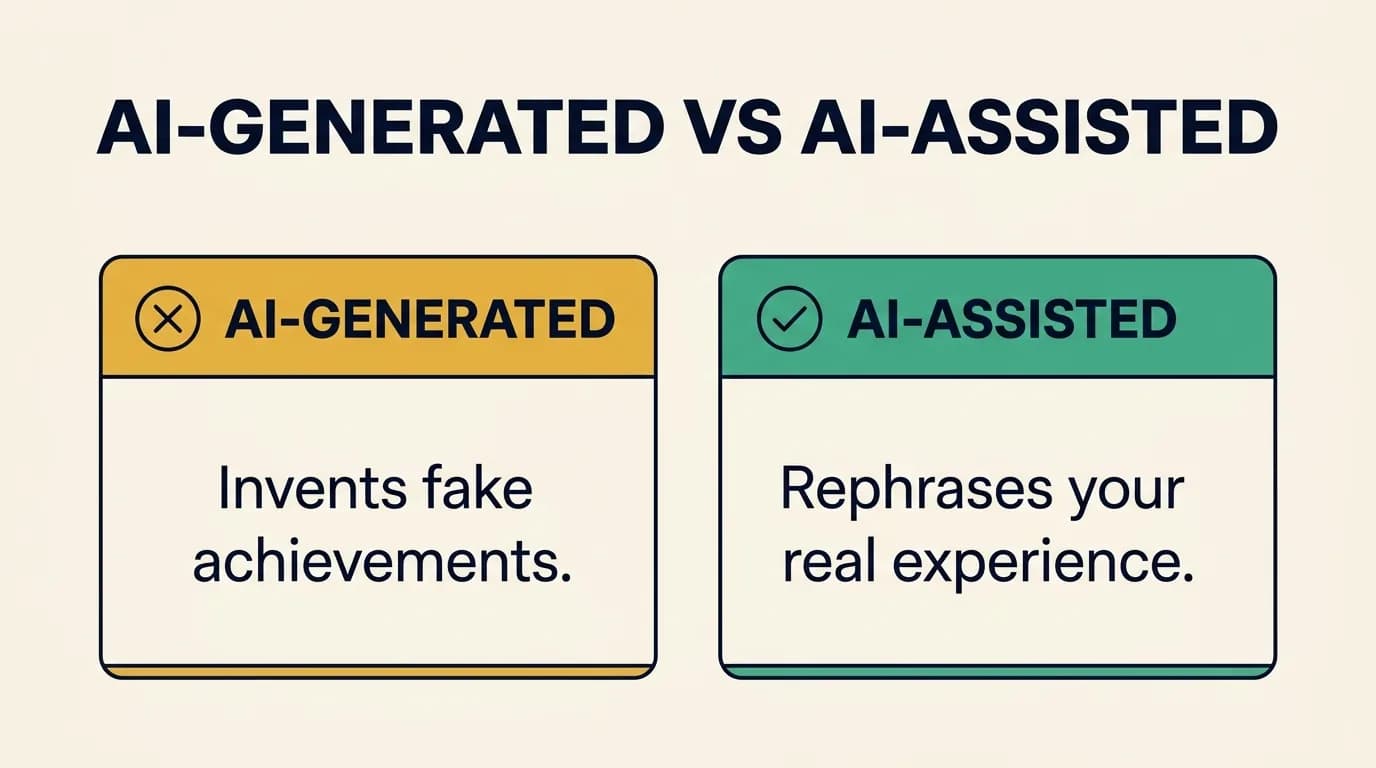
- AI-generated = you let a bot invent a resume from a vague prompt, complete with achievements you never had. Risk: fabrication. That fails the moment a human asks a follow-up question.
- AI-assisted = you use AI to rephrase your real experience, mirror the job's keywords, and tighten weak bullets. Risk: basically none. This is just a faster version of good editing.
The tool isn't the problem. Lying is the problem, and lying was a bad idea long before AI showed up.
Will recruiters know?
Sometimes — but not because of detection software. The tell is generic, soulless AI fluff: "results-driven professional leveraging synergies." A human spots that in a second. Specific, quantified, human-sounding bullets read like a real person, no matter what helped you write them.
How to use AI without the red flags
- Keep your real numbers, titles, and timeline. Edit phrasing, not facts.
- Mirror the job description instead of stuffing keywords.
- Read it out loud. If it sounds like a press release for a stapler, rewrite it.
Use AI the responsible way
Talorr tailors your existing resume to a job — it rewrites how your experience is phrased and surfaces missing keywords, without inventing anything. You stay in control, the resume still sounds like you, and the ATS gets exactly what it's actually looking for: a clean, well-matched document.
Frequently asked questions
- Can an ATS tell if my resume was written by AI?
- No. An ATS parses your resume and matches keywords against the job — it doesn't run an AI-detection scan. What gets resumes filtered out is poor formatting and weak keyword matching, not whether AI helped you write it.
- Is it safe to use AI to write my resume?
- Yes, as long as it's AI-assisted, not AI-fabricated. Use AI to rephrase your real experience and match the job's keywords, but never let it invent jobs, titles, or numbers you can't back up in an interview.