The great catch-22 of early careers: you need experience to get a job, and a job to get experience. Writing a resume with no work history feels like being asked to fill a scrapbook before you've taken any photos. The good news is that "no experience" almost never means "nothing to show" — it means you're measuring the wrong things.
You have more than you think
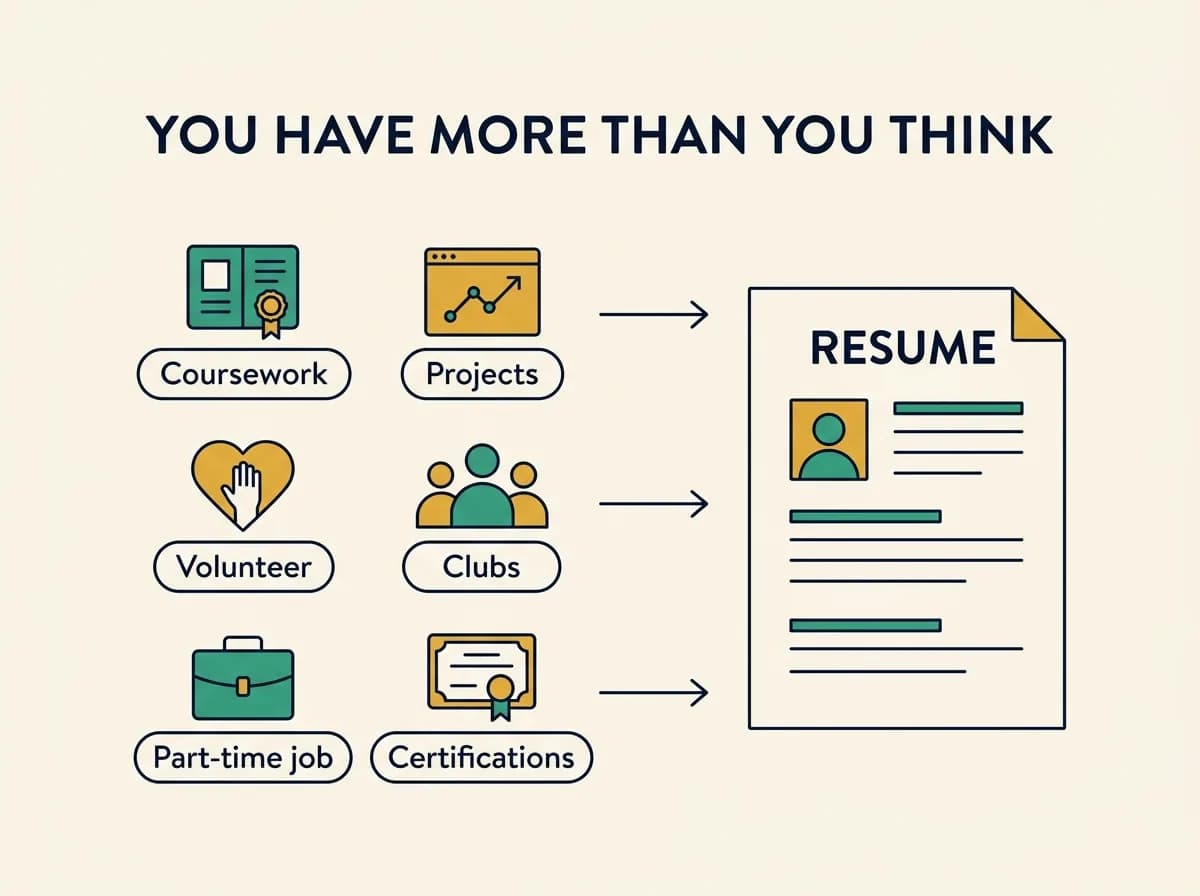
Before you panic about the empty "Experience" section, take inventory. Nearly everyone applying for their first role has some of these:
- Coursework and academic projects — a capstone, a research paper, a group build.
- Volunteer work — organizing, fundraising, coordinating people and time.
- Clubs, sports, and student government — leadership, teamwork, commitment.
- Part-time or seasonal jobs — even unrelated ones show reliability and soft skills.
- Personal projects — a website, an app, an Etsy shop, a YouTube channel.
- Certifications and online courses — proof you can learn independently.
Each of these is legitimate resume material. The skill is framing them as evidence rather than filler.
The structure for a no-experience resume
Flip the usual order to lead with your strengths:
- Contact details — name, email, phone, city, and a LinkedIn or portfolio link.
- A summary — two or three lines naming your field, your top strengths, and your direction. See resume summary examples for the formula; entry-level examples are covered there.
- Education — degree, school, graduation date, relevant coursework, GPA if it's strong.
- Projects — the star of a no-experience resume. Treat each like a job with bullets and results.
- Skills — the tools, software, and languages you genuinely know. Our resume skills guide has role-by-role lists.
- Experience — any part-time, volunteer, or seasonal work, framed with impact.
Turn projects into "experience"
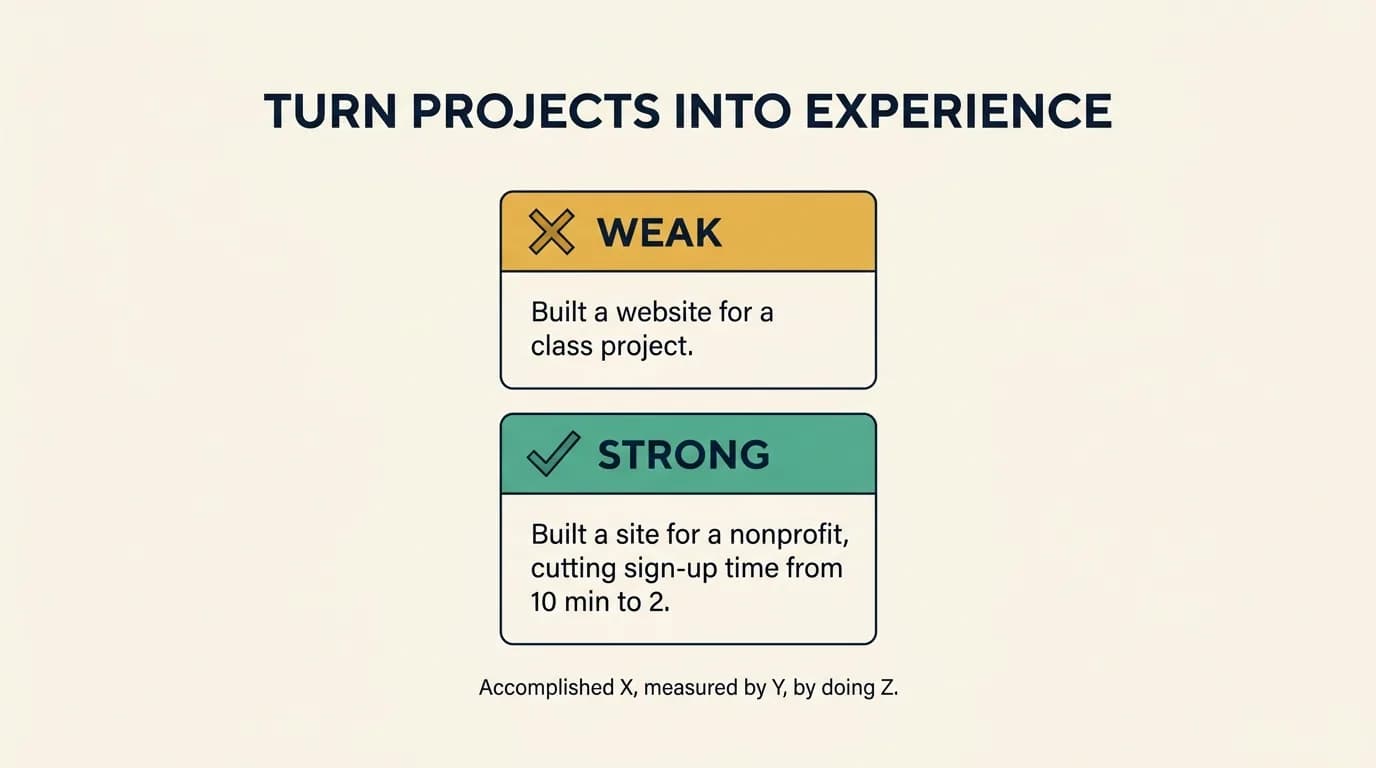
This is the whole game. A project written as a task list is invisible; the same project written as bullet points with results reads like real work:
- Weak: "Built a website for a class project."
- Strong: "Designed and built a responsive site for a local nonprofit in a 4-person team, cutting their event sign-up time from 10 minutes to 2."
Same project. One sounds like homework; the other sounds like a hire. Use the formula: accomplished X, measured by Y, by doing Z — and quantify with users, hours, percentages, or team size wherever you honestly can.
A sample summary for a new grad
Computer science graduate with two internships shipping production features and a capstone app used by 500+ students. Comfortable across the stack with Python, React, and SQL, and eager to grow as a backend engineer.
It names the field, proves it with scope, lists real tools, and points somewhere. That's all a first-job summary needs to do. For a full worked example, see our student resume example.
Mistakes to avoid
- The dreaded objective. "Seeking a challenging role to grow my skills" is about you. Use a summary that leads with what you offer.
- Listing every class. Include only coursework relevant to the role.
- Claiming skills you can't defend. A "fast learner" who freezes in the interview is worse than an honest beginner.
- Ignoring the ATS. Even entry-level roles run resumes through filters. Keep formatting clean and mirror the posting's keywords — see how to optimize your resume for ATS.
The bar is lower than you fear
Employers hiring for entry-level roles expect limited experience. What separates candidates is how clearly they present the proof they do have. Frame your projects and transferable skills as achievements, keep it tailored and clean, and your lack of a long work history stops being the story. Talorr helps you build a first resume from a template, quantify your projects, and check it against any job before you send it.
Frequently asked questions
- How do I write a resume with no work experience?
- Lead with a summary, education, and a strong projects section instead of a work-history section. Frame coursework, volunteer work, clubs, and personal projects as achievements with quantified results, list the skills you genuinely have, and keep the formatting clean and ATS-friendly.
- What do I put on a resume if I have no experience?
- Include your education and relevant coursework, academic and personal projects written as bullet points with results, volunteer and extracurricular leadership, any part-time or seasonal jobs, certifications, and a skills section. These are all legitimate evidence of ability for an entry-level role.
- Should a student resume have a summary or an objective?
- A summary. Objectives focus on what you want; a two-to-three-line summary that names your field, top strengths, and direction gives the recruiter context and frames the rest of the page far more effectively.