Writing a cover letter feels like being asked to write a love letter to a stranger who may never read it. Good news: there's a formula, it's short, and once you know it you can write a genuinely good cover letter in about ten minutes. The trick is to stop treating it as a formal essay and start treating it as a five-second audition for the recruiter's attention.
Do you even need one?
Send a cover letter when the application asks for one, when you're changing careers and need to connect the dots, or when the role is competitive enough that a strong note tips the decision. Skip it only when the posting explicitly says not to include one. When in doubt, send one — a good letter rarely hurts, and a missing one occasionally does. (For the difference between the two documents, see cover letter vs resume.)
The four-paragraph structure
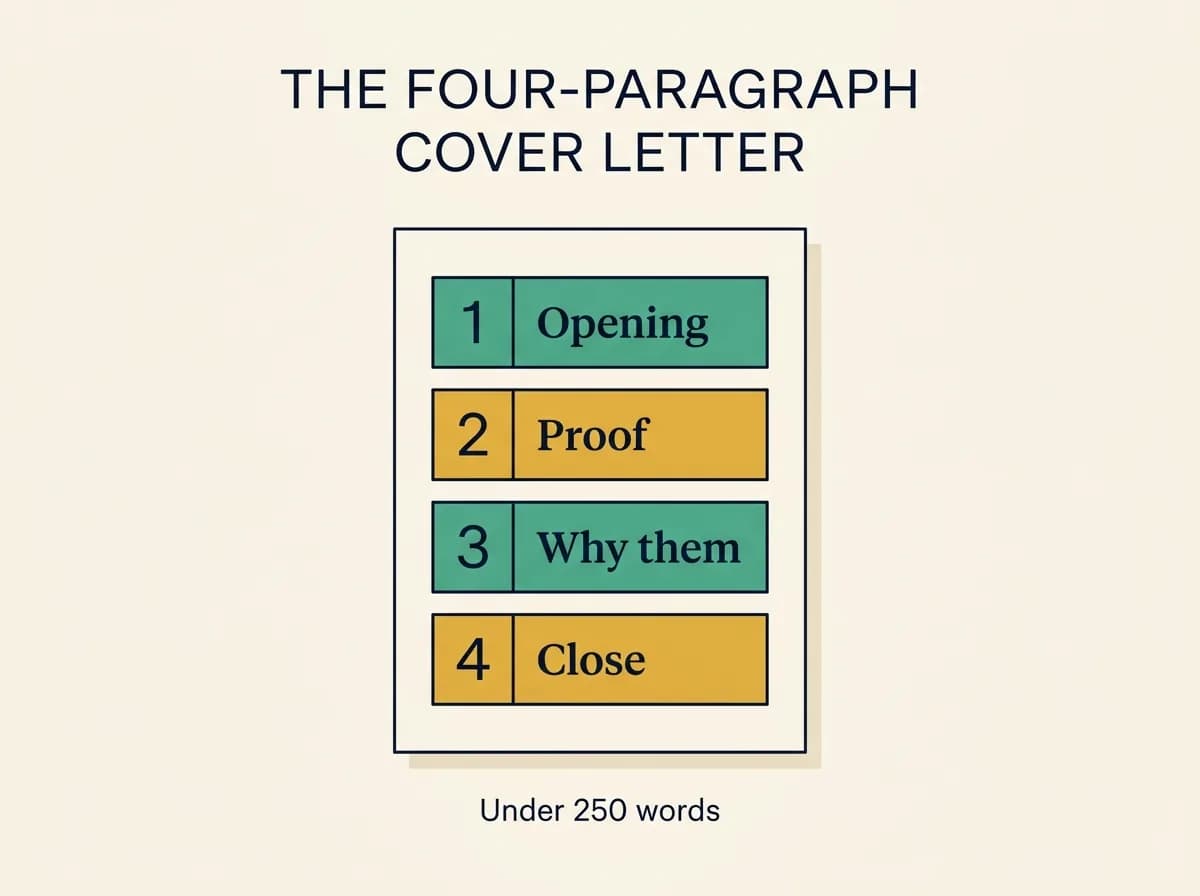
Forget the five-paragraph essay your English teacher loved. A modern cover letter is four short paragraphs:
- The opening. Name the role and lead with a specific reason you're a strong fit. Never open with "I am writing to apply for the position of…" — the recruiter knows why you're writing.
- The proof. One or two concrete, quantified achievements that map to the job's top requirements. This is where you earn the read.
- The why-them. A specific reference to the company, product, or mission that proves you did more than paste the same letter into 40 applications.
- The close. A confident, brief sign-off with a clear next step. Our guide on how to end a cover letter covers this in detail.
Keep the whole thing under 250 words. Recruiters skim, so brevity is a feature — the full case is in how long a cover letter should be.
A full example
Here's the structure in action, for a marketing coordinator role:
Dear Hiring Manager,
I've spent three years turning quiet social channels into pipeline, so your opening for a Marketing Coordinator who "owns content and reporting" reads like my job description.
At Brightline, I grew our LinkedIn following 140% in a year and built the weekly reporting dashboard the whole team now runs on. When our webinar sign-ups stalled, I rewrote the email sequence and lifted registrations 32%.
What pulls me toward your team specifically is your focus on education-first content — it's the approach I've argued for internally for years, and I'd love to do it somewhere it's already the default.
I'd welcome the chance to talk about how I can help. Thank you for your time.
Emma Carter
Notice: no filler, a number in almost every line, and one genuine, specific reason for wanting this job.
How to address it
Use the hiring manager's name if you can find it (LinkedIn, the company site, the job poster). "Dear [First Name]" or "Dear Ms. Lopez" beats "To Whom It May Concern" every time. If you genuinely can't find a name, "Dear Hiring Manager" is the safe fallback — the full breakdown is in how to address a cover letter without a name.
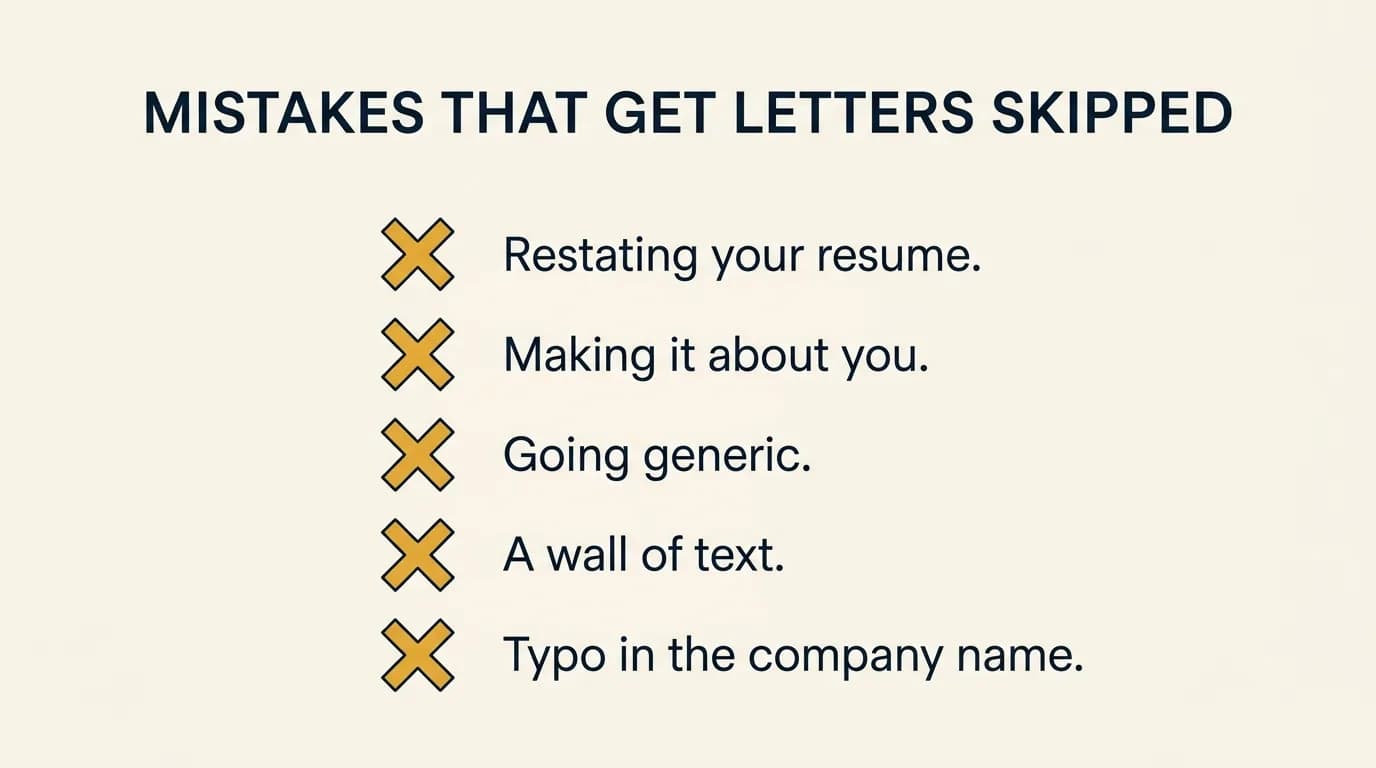
Common mistakes that get letters skipped
- Restating your resume. The letter should add color and context, not repeat your bullet points line for line.
- Making it about you. "This role would help me grow" is about your needs. Lead with what you bring.
- Going generic. If you could swap in any company name without changing a word, it's not a cover letter, it's a form letter.
- Writing a wall of text. Four short paragraphs. White space is your friend.
- Typos in the company name. Instant credibility killer. Read it twice.
Role-specific versions
Different fields have their own conventions. If you're in a technical field, see our engineering cover letter guide; if you're a student, the internship cover letter guide covers the no-experience angle; and for academia, cover letters for a journal submission follow their own format entirely.
Let AI do the first draft
Staring at a blank page is the hardest part, and it's exactly the part AI is good at. Talorr's cover letter generator reads the job and your resume, drafts a tailored four-paragraph letter that mirrors the role's priorities, and lets you edit it inline — so you add the human spark instead of fighting a blank page. See AI cover letters for how to use it without sounding like a robot. Write the draft in a minute, spend your energy on the one paragraph that makes it yours.
Frequently asked questions
- How do I write a cover letter?
- Use four short paragraphs: an opening that names the role and your strongest fit, a proof paragraph with one or two quantified achievements, a why-this-company paragraph that shows genuine research, and a brief confident close. Keep it under 250 words and address it to the hiring manager by name where possible.
- How long should a cover letter be?
- Under about 250 words, in four short paragraphs that fit comfortably on half a page. Recruiters skim, so a tight, specific letter beats a full page of prose almost every time.
- Should I use AI to write my cover letter?
- Yes, for the first draft and structure — it's fast and effective. Just add the specific, genuine reason you want that particular role yourself, and edit the opening and why-this-company paragraph in your own words so it doesn't read as generic.