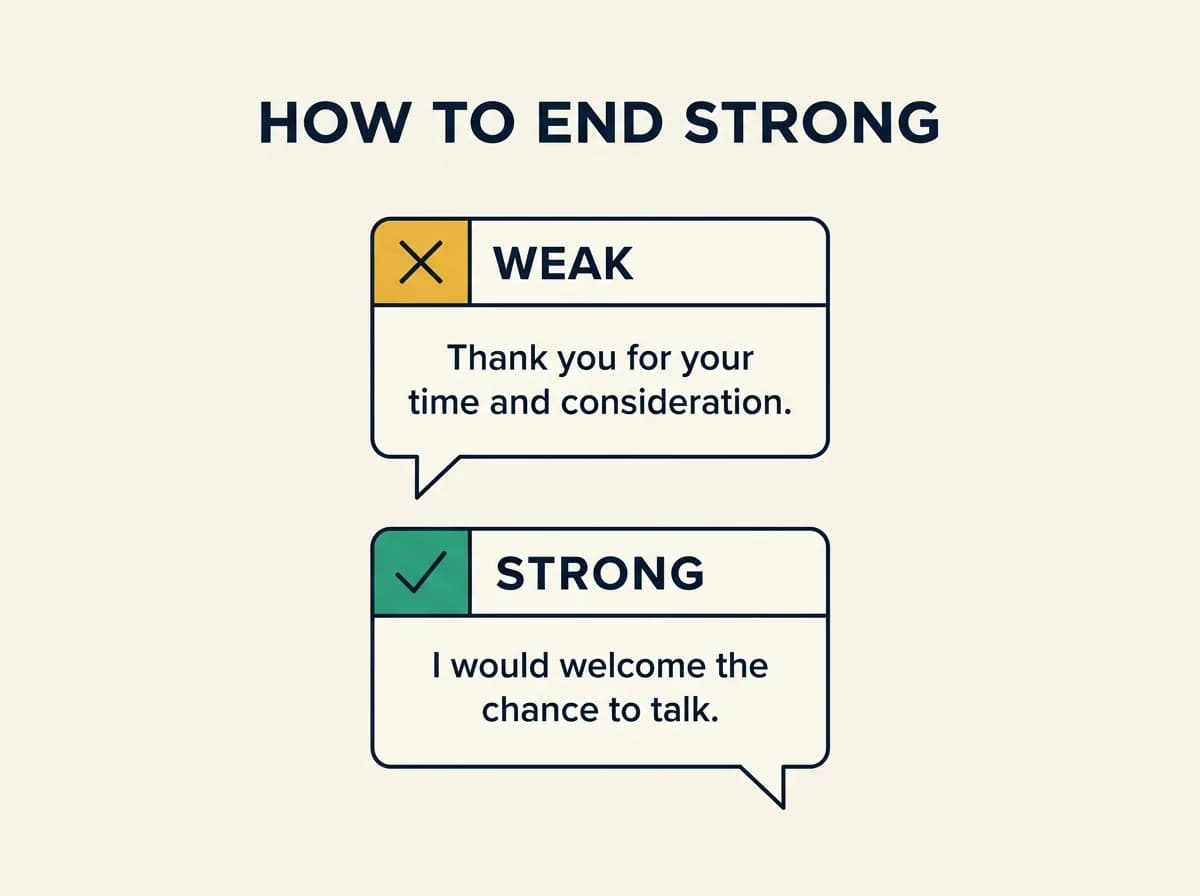
You can nail the whole cover letter and then end it like a balloon slowly losing air: "Thank you for your time and consideration." Snooze. The closing is your last impression, and a confident one nudges the reader toward the next step. Here's how to land it.
What a strong closing does
Three jobs in two sentences: restate your fit in a confident (not arrogant) tone, signal genuine interest in a conversation, and make the next step obvious. Then sign off cleanly.
Closing lines that work
I'd welcome the chance to show how I can speed up your release cycle for the platform team. I'm available for a call at your convenience.
I'm excited about your work on developer tooling and would love to discuss how my backend experience fits. Thanks for reading.
Notice the pattern: specific, forward-looking, no begging.
Closings to avoid
- "Thank you for your time and consideration." Everyone writes it. It says nothing.
- "I hope to hear from you." Passive. You hope?
- "Please don't hesitate to contact me." Stiff and dated.
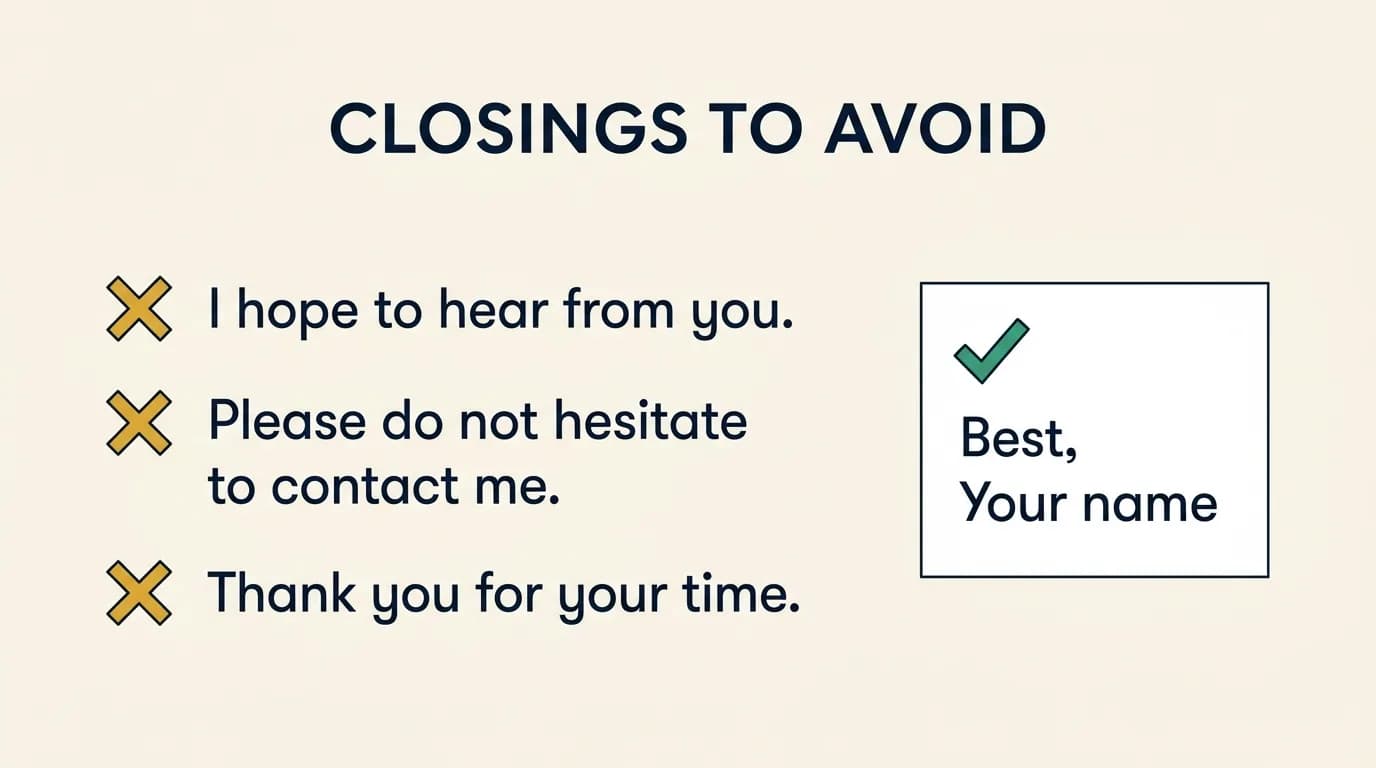
The sign-off
Keep it simple: "Best," or "Sincerely," followed by your name. Pair it with a clear close above and you're set. If you're sending it cold, line this up with how to address a cover letter without a name.
Don't overthink the whole thing
The close matters, but so does length. Aim for the right cover letter length: under 250 words, four short paragraphs.
Let Talorr land the close for you
Talorr's cover letter generator drafts a tailored letter (strong opening, quantified proof, and a confident close) from the job and your resume, so you never stare at a blinking cursor wondering how to wrap up.
Frequently asked questions
- What is the best way to end a cover letter?
- Close with a confident, specific line that restates your fit and invites a conversation, then sign off with 'Best,' or 'Sincerely,' and your name. Avoid generic filler like 'thank you for your time and consideration.'
- Should I say thank you at the end of a cover letter?
- A brief thanks is fine, but don't make it the whole closing. Lead with a confident, forward-looking line about the next step, and let a short 'thanks for reading' sit alongside it rather than carry it.