"How long should my resume be?" is the most common resume question there is — and the honest answer is: long enough to prove you fit, short enough that every line earns its place. Length is a function of relevant experience, not a vanity target. Nobody in the history of hiring has been rejected for a resume that was too easy to read.
The rule of thumb
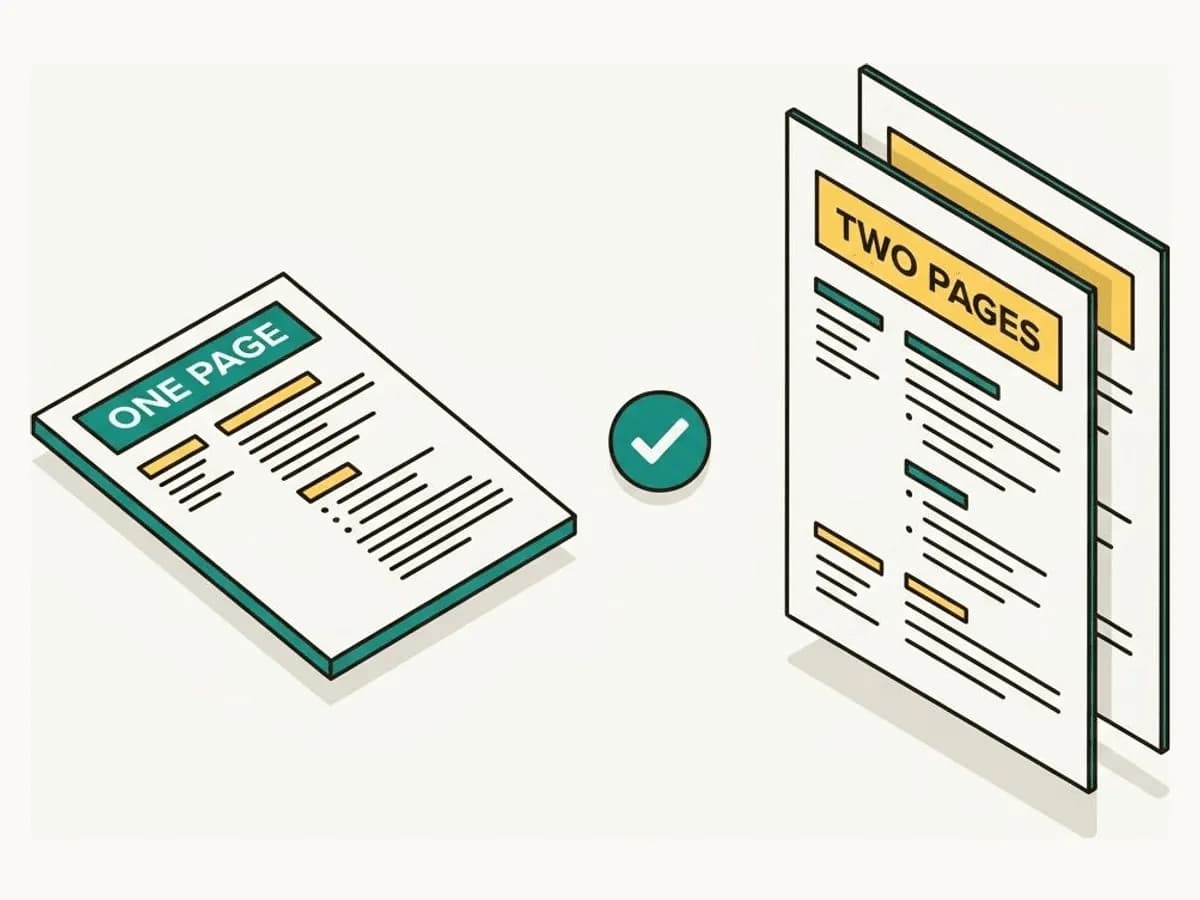
- One page — students, new graduates, and anyone with under ~10 years of relevant experience.
- Two pages — mid-level and senior professionals with a decade or more of relevant roles, or a body of work that genuinely needs the space.
- Three+ pages — reserved for academic CVs, medical, or senior research roles where publications and grants are expected.
The goal isn't to fill a page or to squeeze onto one — it's signal density. A one-page resume padded with filler is weaker than a tight two-page resume full of evidence.
Why recruiters skim, not read
Recruiters spend their first pass scanning, not reading. Studies consistently show the combination of your professional summary and the first 2–3 bullets under your most recent role is what gets read in the opening seconds. If those blocks are weak, the rest rarely gets attention — no matter how long the document is.
How to cut a resume down to size
- Drop roles older than ~15 years unless they're directly relevant.
- Trim early-career bullets to one or two lines each; keep the detail on recent roles. Our guide to writing resume bullet points shows how to make each one carry its weight.
- Remove the obvious — "Microsoft Office," "team player," and references-available lines add length, not signal.
- Merge or cut a skills wall that repeats what your bullets already prove. Keep only the skills that matter for the role.
- Tighten the language — lead with a verb, cut adverbs, and let numbers carry the weight.
When two pages is the right call
Don't amputate real, relevant achievements just to hit one page. If you're senior and your second page is full of quantified, role-relevant impact, two pages is correct and expected. The mistake is a second page that's mostly whitespace and stale history.
Formatting that keeps it readable
- Single-column, reverse-chronological layout (also best for ATS parsing).
- Consistent date formatting and clear section headers.
- Enough margin and line spacing that it doesn't read as a wall of text.
Talorr's templates handle the formatting for you and show a live preview as you edit, so you can see exactly where your resume breaks onto a second page — and decide what's worth keeping. Whatever the length, the goal is the same: make every line stand out and keep it readable by the ATS.
Frequently asked questions
- Should a resume be one page or two?
- Use one page if you have under about 10 years of relevant experience, and two pages if you're mid-level or senior with a decade or more of relevant roles. Never pad to fill space or cut real achievements just to hit one page.
- What should I remove to shorten my resume?
- Cut roles older than ~15 years, trim early-career bullets to one or two lines, and remove generic filler like 'Microsoft Office,' 'team player,' and 'references available on request.'