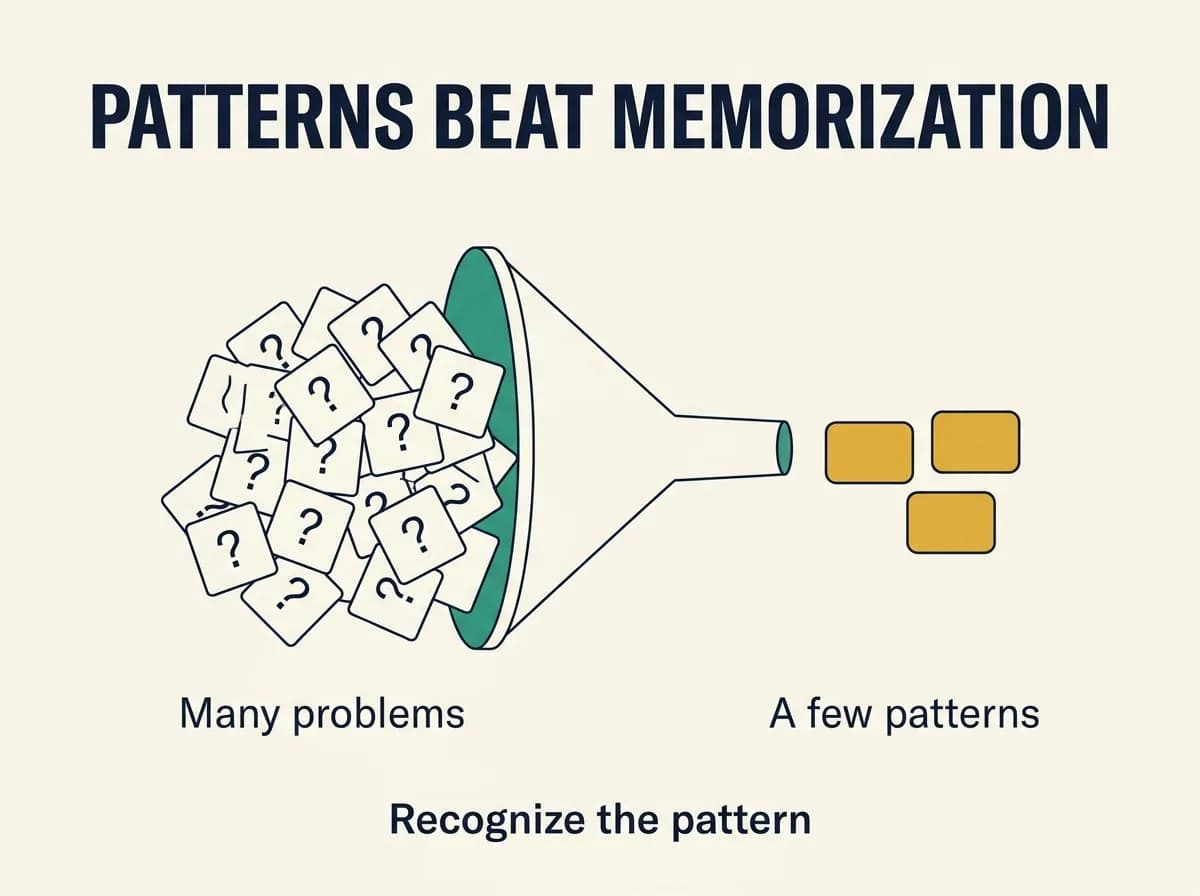
Behavioral interviews feel unpredictable, but they're the most predictable round there is. Almost every question is a different door into the same handful of themes, and once you see the themes, fifteen questions collapse into six or seven prepared stories. It's the same seven ingredients rearranged — behavioral rounds are basically a diner menu pretending to offer fifteen different meals. Here are the questions you'll actually face and what each is really testing.
Why these questions repeat
Interviewers use behavioral questions to predict future behaviour from past behaviour. They're listening for ownership ("I," not "we"), a specific example rather than a general philosophy, and a real result. The questions vary; the scoring rubric barely changes.
Leadership and initiative
- Tell me about a time you led a project or a team.
- Describe a time you took initiative without being asked.
- Give an example of a time you influenced someone without authority.
These test whether you drive outcomes. Lead with the decision you owned and the result you produced.
Conflict and collaboration
- Tell me about a conflict with a coworker and how you resolved it.
- Describe working with a difficult stakeholder.
- Give an example of feedback you received and how you acted on it.
These test maturity. Stay specific, avoid blaming, and show what you changed.
Failure and resilience
- Tell me about a time you failed.
- Describe a mistake you made and what you learned.
- Give an example of a time you missed a deadline.
These test self-awareness. Name a genuine failure, own it cleanly, and spend most of the answer on what you changed afterwards.
Ambiguity and problem-solving
- Tell me about a time you solved a hard problem.
- Describe a situation with unclear requirements and how you handled it.
- Give an example of a decision you made with incomplete information.
These test judgement. Show how you created clarity, not that you happened to be right.
Motivation and fit
- Why do you want to work here?
- Tell me about a time you went above and beyond.
- Where do you see yourself growing?
These test whether you'll stay and care. Connect your answer to something specific about the role and team.
The answer framework
Use the STAR method for every one: a sentence of Situation, the Task you owned, the Actions you took in first person, and a quantified Result. Spend about 60% of the answer on your actions and close with a number whenever you can. Keep each answer to 90 seconds to two minutes.
Build the story bank, not fifteen scripts
You don't need a unique answer per question. Prepare 6–8 versatile stories from real experience covering leadership, conflict, failure, initiative, ambiguity, customer focus, and growth. Map each of the questions above to one of those stories and you've covered almost any behavioral round.
Rehearse out loud against the role
Reading stories isn't practising them. Talorr's AI mock interviews run role-grounded behavioral rounds using the STAR framework and give you a scorecard, so you can rehearse these exact questions aloud and tighten your answers before the real thing. Prepare the stories, then pressure-test them — and slot this into the bigger picture with how to prepare for a technical interview.
Frequently asked questions
- What are the most common behavioral interview questions?
- The most common ones cluster around leadership, conflict, failure, ambiguity, and motivation — for example 'tell me about a time you led a project,' 'describe a conflict you resolved,' and 'tell me about a time you failed.' Most questions are variations on these themes.
- How do I answer behavioral questions I haven't prepared for?
- Map the question to one of your prepared STAR stories. With 6–8 versatile stories covering the core themes, almost any behavioral question is just a different way into a story you already have.