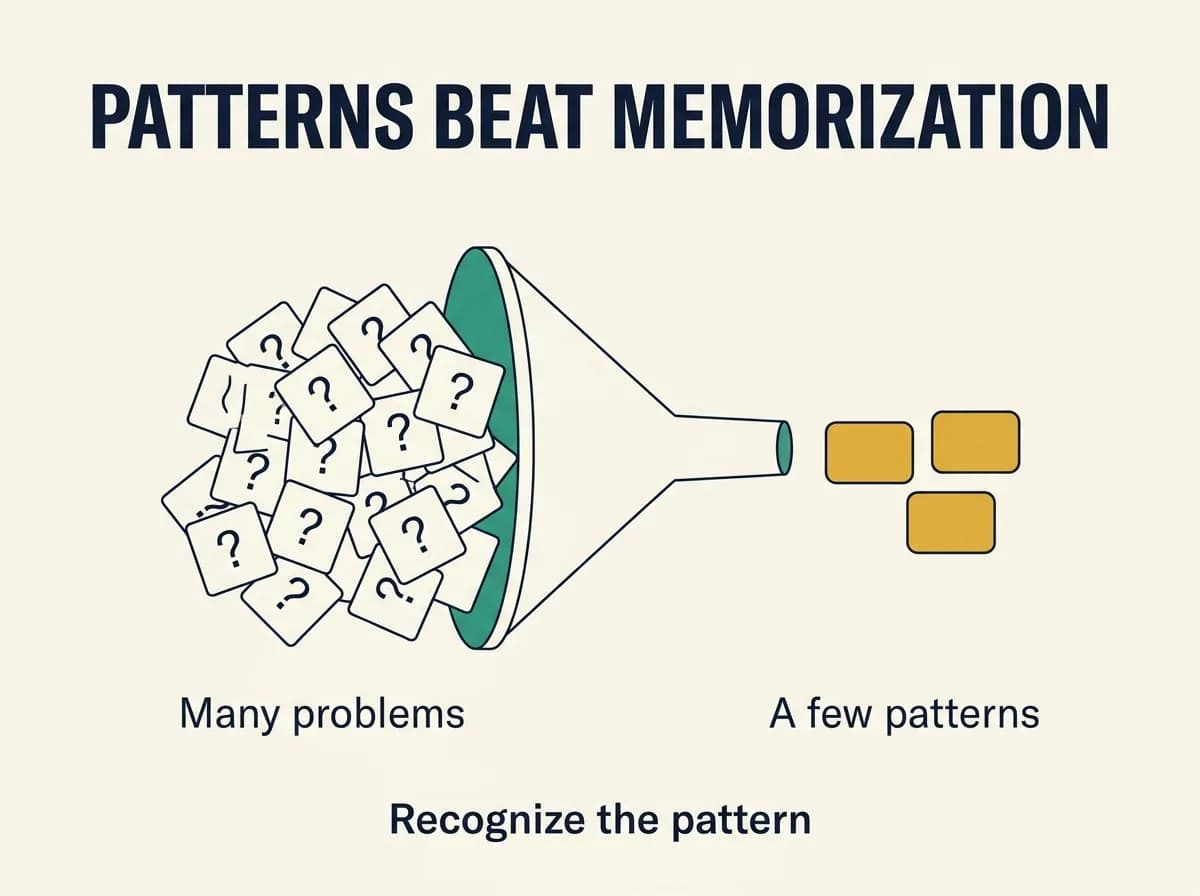
Trying to memorize your way through coding interviews is like trying to memorize every possible chess game: technically heroic, practically doomed. Interviewers aren't testing whether you've seen a specific problem — they're testing whether you recognise the pattern underneath it. Learn the dozen or so patterns and hundreds of questions collapse into a handful of familiar shapes.
Why patterns beat problem counts
Two candidates solve 200 problems. One grinds them top to bottom and forgets most. The other, after each problem, writes a sentence naming the pattern and the trigger that signals it. In the interview, the second candidate sees a new problem, recognises "this is a sliding-window problem," and is halfway to the answer before writing a line. Patterns are how you turn practice into recall under pressure.
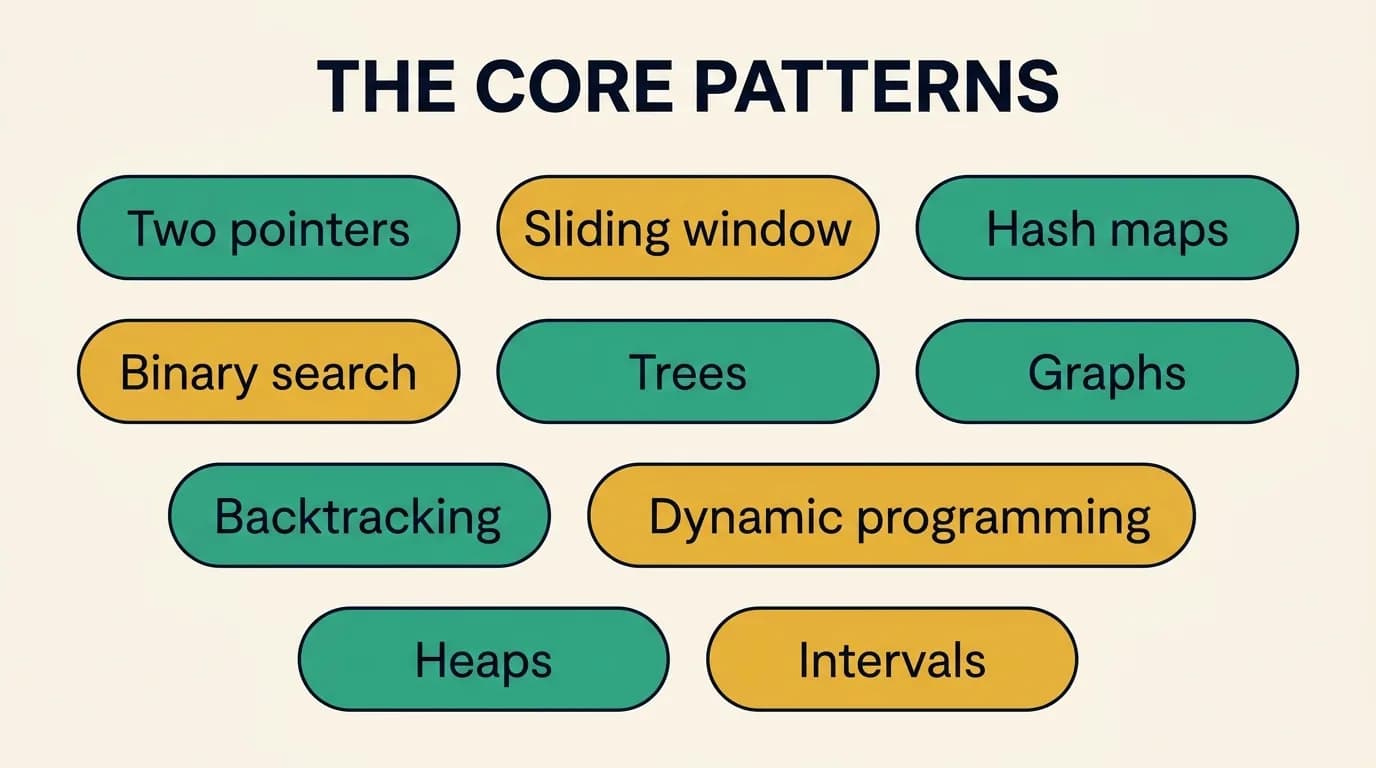
The core patterns to master
Most questions at most companies come from this set:
- Two pointers — pairs, palindromes, sorted-array scans.
- Sliding window — longest/shortest substring or subarray meeting a condition.
- Hash maps / frequency counts — "have I seen this before?" in one pass.
- Binary search — sorted data, or a monotonic answer space.
- Trees (BFS/DFS) — level-order, path sums, recursion on structure.
- Graphs (BFS/DFS, topological sort) — connectivity, shortest paths, dependencies.
- Backtracking — permutations, combinations, "generate all valid…".
- Dynamic programming — overlapping subproblems: knapsack, LCS, grid paths.
- Heaps / priority queues — "top K," running medians, merging streams.
- Intervals — merging, overlaps, scheduling.
Example questions by pattern
- Sliding window: "Longest substring without repeating characters."
- Two pointers: "Given a sorted array, find two numbers that sum to a target."
- Hash map: "Find the first non-repeating character in a string."
- BFS: "Return the level-order traversal of a binary tree."
- Backtracking: "Generate all valid combinations of n pairs of parentheses."
- DP: "Given coin denominations, find the fewest coins that make an amount."
When a new question appears, don't ask "have I seen this exact one?" Ask "which pattern does this smell like?" That reframe is the entire skill.
A note for Python developers
Python is a common interview language for good reason — it gets out of your way. Know your standard library cold: collections.Counter and defaultdict for frequency problems, heapq for top-K, deque for BFS and sliding windows, and bisect for binary search. Interviewers won't ding you for using them; they'll notice if you reinvent them badly. If you're targeting Python roles, pair this with a strong Python developer resume so you actually reach the interview.
How to practice each problem
- Read it and restate it in your own words.
- Name the pattern out loud before writing code.
- Talk through the approach and the complexity, then code it.
- Dry-run it against an edge case (empty input, one element, duplicates).
- If you were stuck over 25 minutes, study the solution, then re-solve from scratch within two days.
Fifty problems you can re-solve and explain beat two hundred you copied. Quality is the whole point.
Don't practice silently
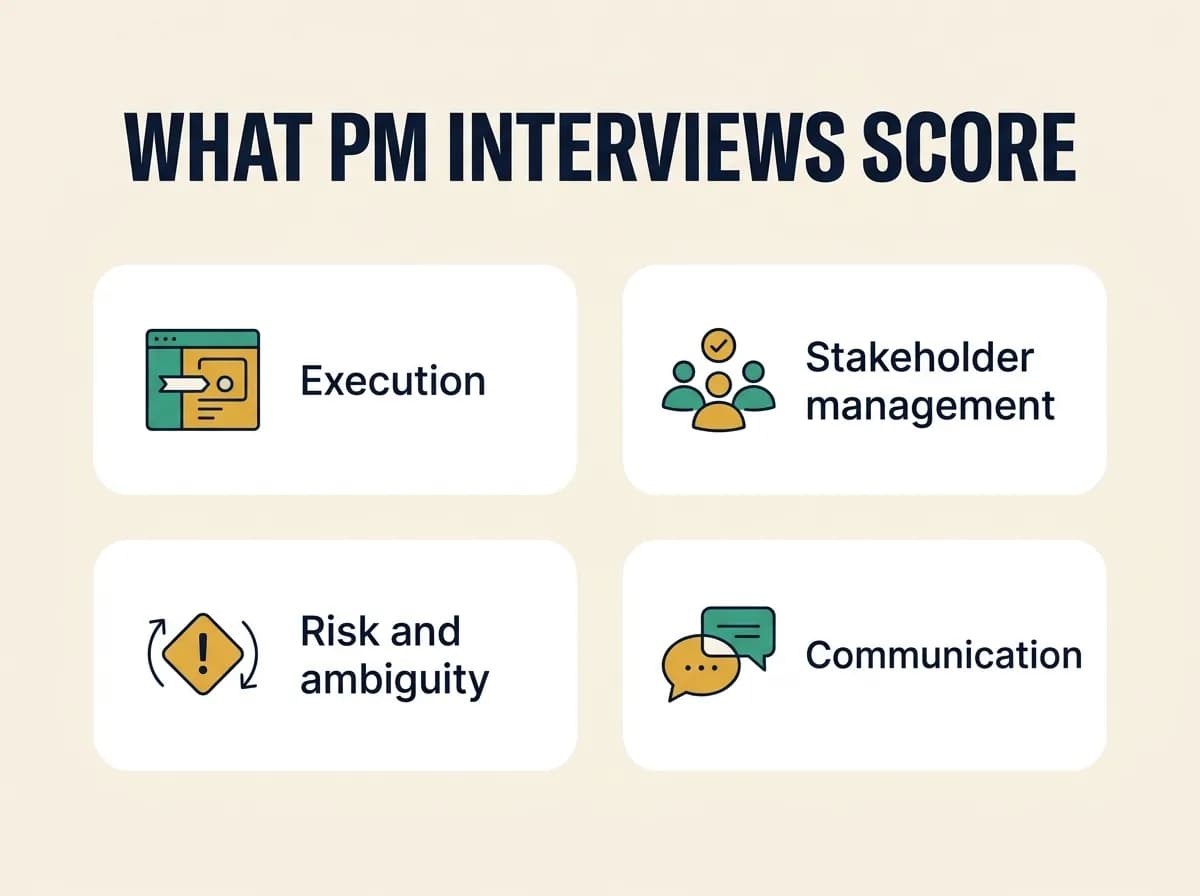
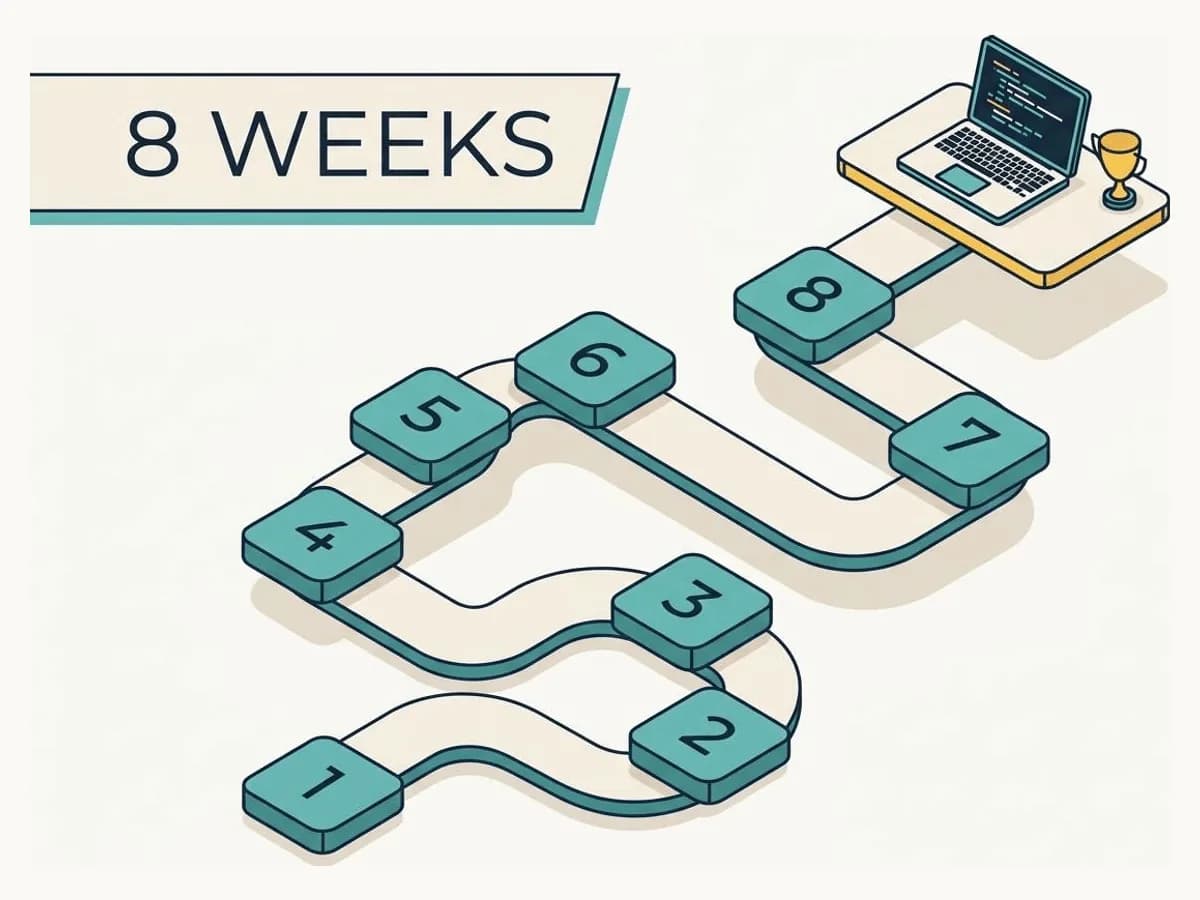
Interviewers score communication as much as correctness. Narrate your thinking, ask clarifying questions, and state trade-offs. A correct-but-silent solution loses to a slightly-slower-but-clear one more often than you'd think. Our 8-week coding interview plan builds this habit week by week, and how to prepare for a technical interview covers the rounds around the coding one.
Bring it together
Learn the patterns, drill a handful of problems per pattern until the trigger is automatic, then rehearse out loud under time pressure. Talorr's Interview Prep pairs real problems solved against a live judge in eight languages with AI mock interviews that ask follow-ups and score you — so the patterns you learn here get tested the way they will be on the day.
Frequently asked questions
- What are the most common coding interview question patterns?
- The core patterns are two pointers, sliding window, hash maps, binary search, tree and graph traversal (BFS/DFS), topological sort, backtracking, dynamic programming, heaps, and intervals. Most questions at most companies are variations on this set, so recognising the pattern is more valuable than memorizing individual problems.
- How many problems should I solve for a coding interview?
- Around 100–150 problems you can re-solve and explain, spread across the core patterns, beats several hundred you only copied. Focus on covering each pattern and being able to name the trigger for it, not on hitting a raw problem count.
- Is Python good for coding interviews?
- Yes. Python's concise syntax and rich standard library (Counter, defaultdict, heapq, deque, bisect) let you focus on the algorithm rather than boilerplate. Interviewers accept idiomatic standard-library use, so know those tools well.