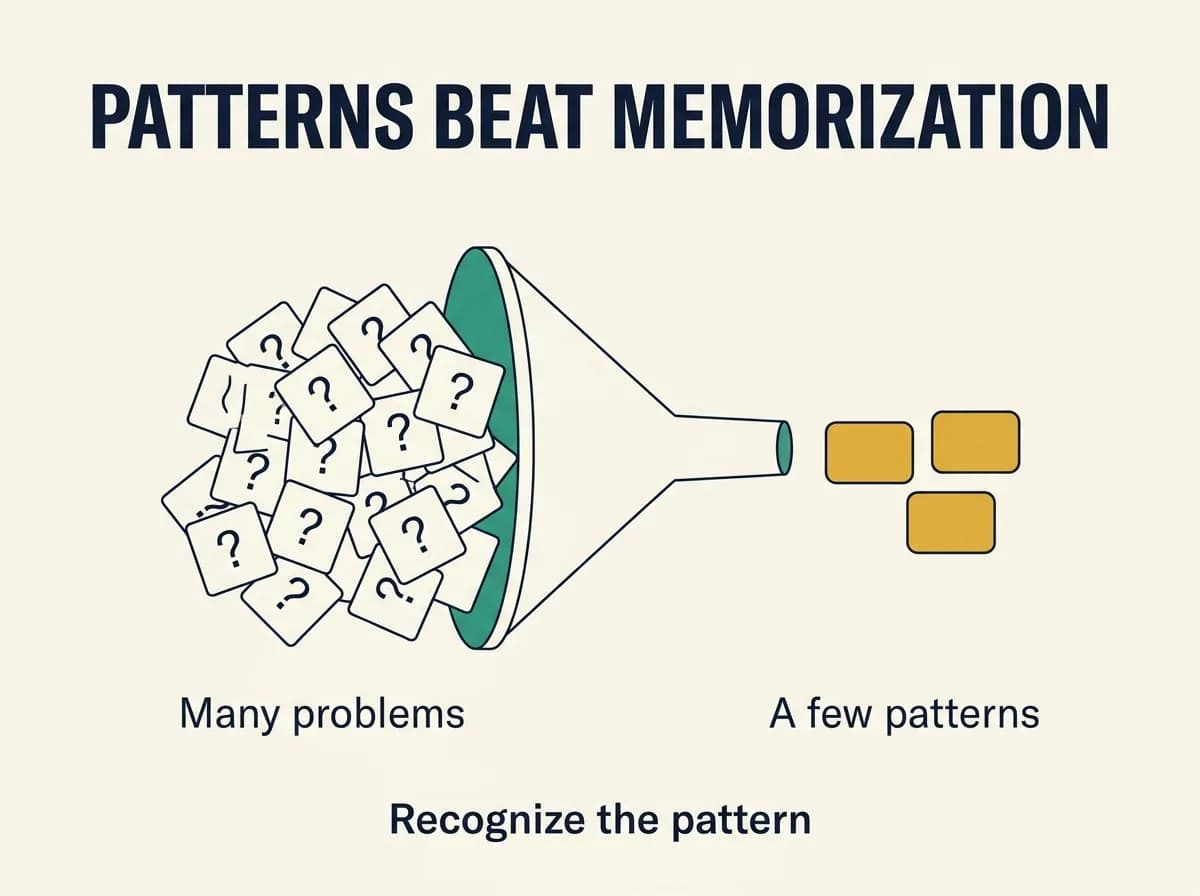
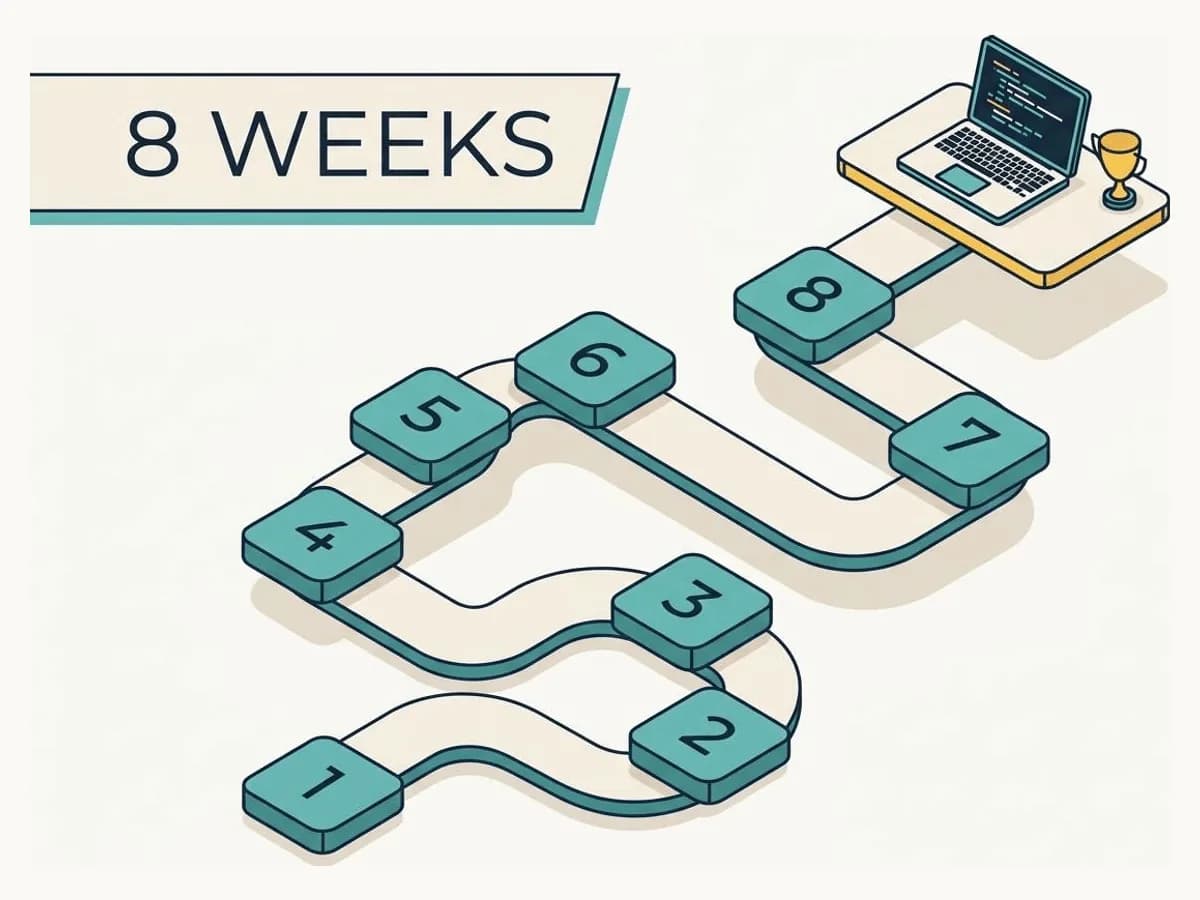
Most people prepare for coding interviews by opening a problem list and grinding from the top until they burn out. It feels productive and rarely works, because interviews don't test whether you've seen 500 problems — they test whether you recognise the handful of patterns underneath them. Grinding 500 random problems is the coding-interview version of buying gym equipment and using it to dry your laundry. This is a realistic eight-week plan that builds those patterns instead of your anxiety.
Before week one: set the target
Pick the level and company type you're aiming for, because it sets the bar. A new-grad screen leans on arrays, strings, and hash maps; a senior loop adds system design and harder graph and dynamic-programming questions. Be honest about your starting point so the plan fits the time you actually have.
Weeks 1–2: foundations and patterns
Spend the first two weeks on the core data structures: arrays, strings, hash maps, two pointers, and sliding window. Solve 3–4 problems per pattern, but after each one, write a single sentence naming the pattern and the trigger that should remind you to use it. That sentence is worth more than the solution.
- Don't move on until you can re-solve a problem from scratch a day later.
- Track every problem you miss in a list — that list becomes your revision set.
Weeks 3–4: trees, graphs, and recursion
Move to trees, binary search, recursion, backtracking, and basic graph traversal (BFS and DFS). These intimidate people, but they are the most pattern-heavy area, which means they reward this kind of practice the most. Aim for 4–5 problems per topic and force yourself to explain the recursion out loud.
Weeks 5–6: dynamic programming and harder graphs
Dynamic programming is where most candidates panic. Beat it by drilling the standard forms — 0/1 knapsack, longest common subsequence, and grid paths — until the state and transition feel routine. Add topological sort and shortest-path graph problems. You don't need every variant; you need the templates and the confidence to adapt them.
Weeks 7–8: mock interviews under pressure
Knowing the patterns is not the same as performing them with a clock running and someone watching. Spend the final two weeks doing timed mock interviews: think aloud, state your approach before coding, handle edge cases, and test your solution. This is the single highest-leverage phase, and it's the one people skip.
How to practice each problem
- Read the problem and restate it in your own words.
- Say your approach out loud before writing any code.
- Code it, then dry-run it against an edge case.
- If you were stuck more than 25 minutes, read the solution, understand it, and re-solve it from scratch within two days.
Quality beats volume every time. Fifty problems you can re-solve and explain beat two hundred you copied.
Don't neglect the talking
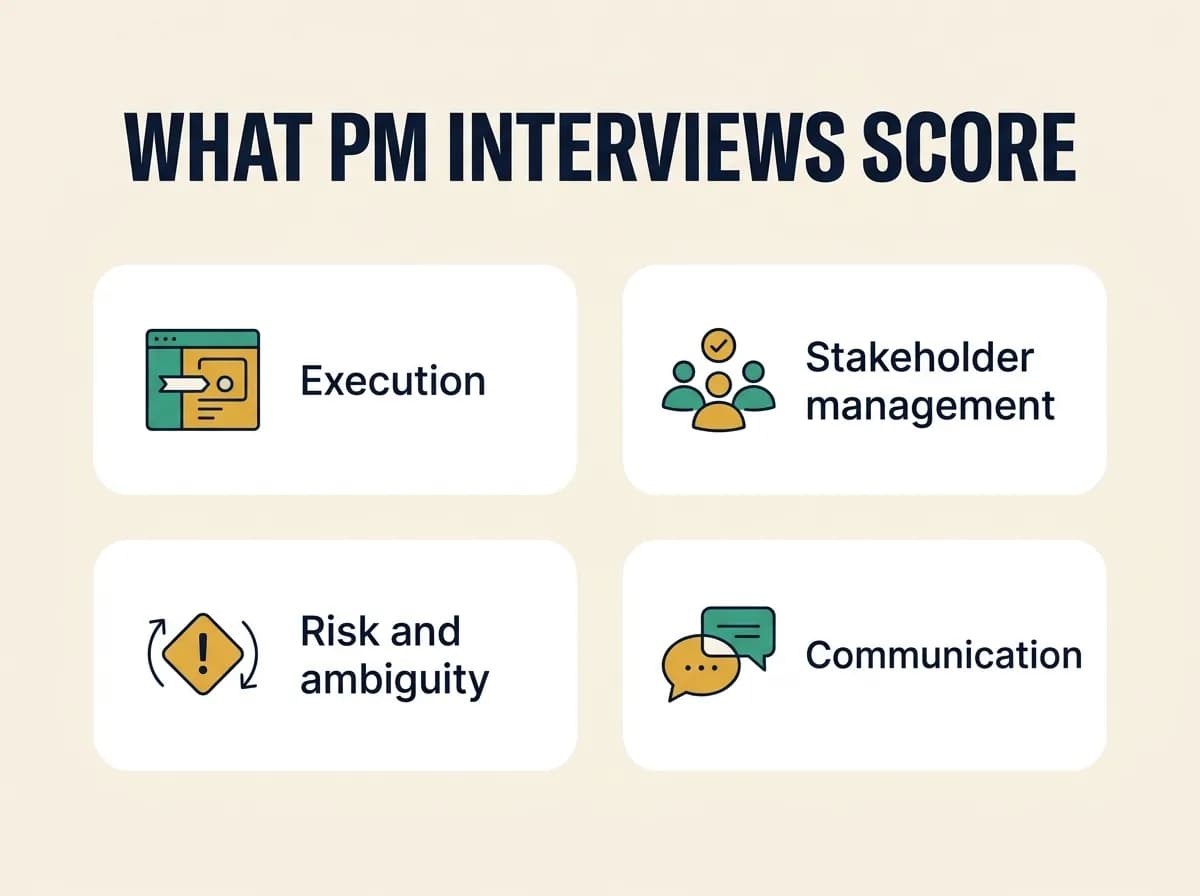
Interviewers score communication, not just correctness. Practising silently trains the wrong skill. Narrate your reasoning, ask clarifying questions, and explain trade-offs — that's what separates a hire from a pass at the same level of correctness. It's also why how to prepare for a technical interview and the behavioral round matter as much as the code — and why a clean software engineer resume is what gets you in the room to begin with.
Practice the real thing, not just the puzzles
Talorr's Interview Prep pairs real coding problems — solved against a live judge in eight languages — with AI mock interviews that ask follow-ups and score you on a clear rubric, so the last two weeks of this plan feel like the interview instead of a worksheet. Build the patterns here, then walk in ready.
Frequently asked questions
- How long does it take to prepare for a coding interview?
- For most candidates, 6–8 weeks of consistent, pattern-focused practice is enough — roughly 1–2 hours on weekdays plus longer mock-interview sessions on weekends. The exact time depends on your starting point and the seniority of the role.
- How many problems should I solve to prepare?
- Aim for quality over quantity: around 100–150 problems you can re-solve and explain beat several hundred you only copied. Focus on covering the core patterns rather than hitting a problem count.