AI has changed resume writing from a weekend chore into a five-minute task — but only if you use it well. Used badly, it produces the exact generic, buzzword-stuffed resume that recruiters now recognise on sight. Used lazily, AI writes a resume so bland it could belong to anyone, which — to a recruiter — means it belongs to no one. Used well, it does the tedious parts and leaves the judgement to you. Here's the line between the two.
What AI is genuinely good at
- Tailoring to a job description. AI can read a posting, extract the priority keywords, and rewrite your bullets to mirror them — the single highest-impact edit for clearing the ATS.
- Turning tasks into achievements. Feed it "managed the social accounts" and it can prompt you toward "grew engagement 35% across three channels," provided you supply the number.
- Tightening language. It's excellent at cutting filler, leading with strong verbs, and fixing inconsistent tense and formatting.
- Drafting summaries. A good first draft of your professional summary, anchored on the target title, in seconds.
What you must keep human
- The facts. Never let AI invent titles, dates, metrics, or skills. Fabrication fails reference checks and technical interviews.
- Your voice. Over-polished AI prose reads as generic. Keep your phrasing where it's already strong.
- Judgement on relevance. You know which achievement matters most for this job; the model is guessing.
How to avoid the generic AI look
The tell-tale signs of a lazy AI resume are vague superlatives ("results-driven professional leveraging synergies"), no numbers, and identical phrasing to thousands of others. Beat them by giving the AI real inputs — your actual metrics, scope, and tools — and asking it to be specific. Specificity is what AI strips out by default and what recruiters reward.
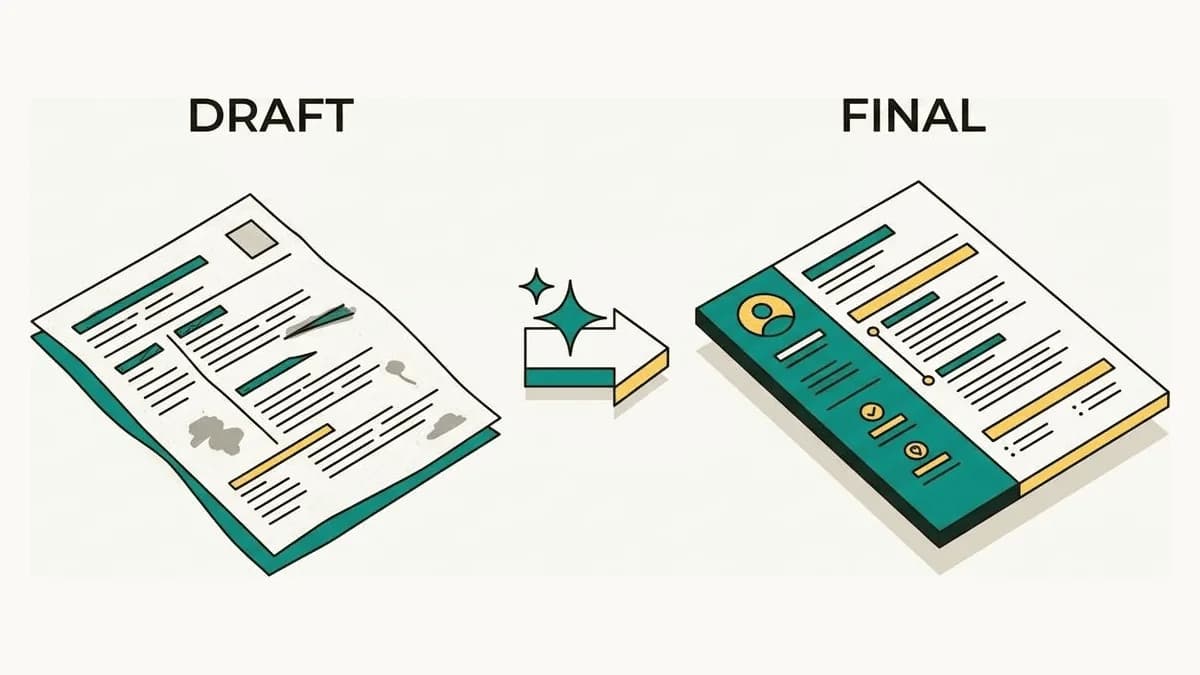
Lazy prompt vs good prompt
The output is only as good as the input. Watch the difference:
- Lazy: "Write me a resume bullet about my marketing job." → You get "Results-driven marketer responsible for driving impactful campaigns." Meaningless.
- Good: "Rewrite this as one resume bullet, lead with a number, keep my voice: I ran our email program, grew the list from 4k to 11k in a year, and lifted revenue from email 22%." → You get "Grew the email list from 4k to 11k subscribers in 12 months and lifted email-driven revenue 22%." Hire-worthy.
Feed it facts, ask for a number up front, and tell it to keep your voice. Everything good comes from the prompt.
A simple, effective workflow
- Paste the job description and your current resume.
- Ask the AI to identify the priority keywords and your missing ones.
- Have it rewrite your top 2–3 bullets per role to mirror the posting — then edit for truth and voice.
- Regenerate your summary to lead with the target title and your strongest relevant result.
- Re-score against the posting and aim for 70–80% keyword overlap, not 100%.
Don't keyword-stuff, even with AI
Modern semantic ATS platforms penalise unnatural repetition. AI can tempt you into stuffing because it's effortless — resist it. Keywords belong in context, next to real results, not piled into a skills wall. If you're unsure which terms matter, our guide to ATS resume keywords shows how to find and place them.
Will the ATS know you used AI?
Short answer: no, and it doesn't care. An ATS can't detect an AI-assisted resume — it scores keywords and formatting, not authorship. So use good tools without fear; just keep every fact true. And if you're deciding between tools, we compared the options in AI resume tailoring tools.
Let purpose-built AI do it properly
General chatbots can do this, but you'll spend the time copy-pasting and re-scoring. Talorr is built for exactly this loop: it reads any job, scores your fit, shows the keywords you're missing, and rewrites weak sections with AI while keeping your wording authentic — then exports a clean, ATS-ready PDF. Use AI for the tedious 90% and keep your judgement for the 10% that wins the interview.
Frequently asked questions
- Is it okay to use AI to write my resume?
- Yes — using AI to tailor, tighten, and rewrite your resume is fine and increasingly standard. The key is to keep every fact true and your voice authentic; never let AI invent titles, metrics, or skills you don't have.
- How do I stop my AI resume from sounding generic?
- Feed the AI real specifics — your actual numbers, scope, and tools — and ask it to be concrete. Generic AI resumes come from vague inputs and superlatives with no metrics, so specificity is what makes the output read as human and credible.